
How Inflation-Driven Cap Rate Hikes Affect Valuations

Real estate investors face constant market shifts. Inflation creates unique challenges for property valuations. Understanding these dynamics helps investors make smarter decisions. At South East on Rent, we help property owners navigate these complex market conditions and maximize their investment returns.
Cap rates serve as essential metrics in real estate investing. They measure a property’s potential return on investment. When inflation rises, cap rates typically follow suit. This relationship significantly impacts how properties are valued in the marketplace.
The connection between cap rates and property values works inversely. Higher cap rates generally mean lower property values. Conversely, lower cap rates often signal higher valuations. Therefore, understanding what happens when cap rates increase to property value becomes crucial for anyone involved in real estate investments. This inverse relationship forms the foundation of property valuation strategies.
Understanding Cap Rates and Their Role
Cap rates represent the ratio between net operating income and property value. Investors use this metric to compare different investment opportunities. A 5% cap rate means the property generates 5% of its value in annual income.
The formula is straightforward. Divide the net operating income by the property’s market value. This calculation provides a quick snapshot of potential returns. However, cap rates don’t tell the whole story about an investment’s quality.
Market conditions heavily influence cap rates. Economic factors like interest rates, inflation, and demand all play roles. Additionally, property-specific factors such as location and condition affect individual cap rates.
How Inflation Drives Cap Rate Changes
Inflation affects nearly every aspect of real estate economics. Rising prices increase operating costs for property owners. Maintenance, utilities, and insurance all become more expensive. These higher costs can squeeze profit margins if rents don’t increase proportionally.
Interest rates typically rise during inflationary periods. Central banks raise rates to combat inflation. Higher borrowing costs make financing more expensive for investors. Consequently, investors demand higher returns to justify the increased risk and cost.
The relationship between inflation and cap rates isn’t always immediate. Sometimes there’s a lag between inflation increases and cap rate adjustments. Market participants need time to digest new information and adjust their expectations accordingly.
According to recent analysis from Forbes, inflation has pushed commercial real estate cap rates higher across most property sectors. This trend reflects the broader economic pressures facing property owners and investors.
The Inverse Relationship Between Cap Rates and Values
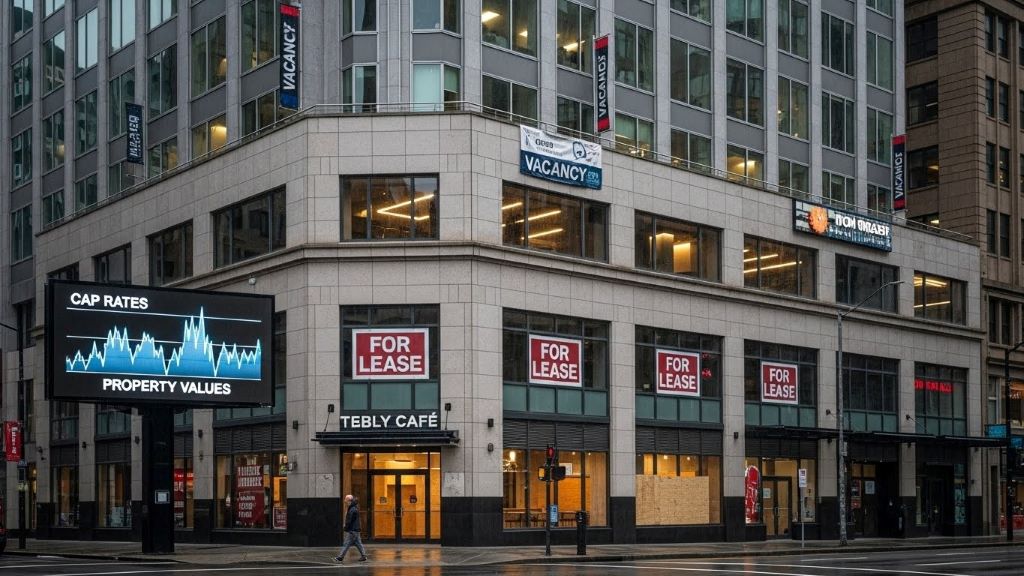
Property values move opposite to cap rates. This inverse relationship is mathematical in nature. When cap rates increase, property values must decrease if income remains constant. The formula makes this clear: Property Value = Net Operating Income / Cap Rate.
Consider a simple example. A property generates $100,000 in annual net operating income. At a 5% cap rate, it’s worth $2 million. However, if the cap rate rises to 6.67%, the same property drops to $1.5 million in value. That’s a 25% decline without any change in the property’s actual performance.
This mathematical reality creates significant implications for property owners. Rising cap rates can erode paper wealth quickly. Investors who bought at low cap rates may face underwater positions if rates spike dramatically.
Impact on Different Property Types
Commercial properties often experience cap rate changes differently than residential properties. Office buildings and retail spaces face unique pressures. Remote work trends and e-commerce growth have reshaped demand patterns significantly.
Multifamily properties generally show more resilience during inflationary periods. People always need housing, regardless of economic conditions. However, rent control laws can limit owners’ ability to pass costs to tenants in some markets.
Industrial properties have seen favorable cap rate trends recently. Strong demand for warehouse and distribution space supports values. E-commerce growth continues driving this sector’s performance, even amid broader economic uncertainty.
Strategies for Navigating Rising Cap Rates
Investors can take several approaches when cap rates rise. Focusing on properties with strong fundamentals provides some protection. Quality locations and well-maintained buildings tend to weather storms better than marginal properties.
Increasing net operating income helps offset cap rate pressure. Property improvements can justify higher rents. Better management practices may reduce operating costs. These operational enhancements directly impact the numerator in the valuation formula.
Value-add opportunities become more attractive during high cap rate environments. Purchasing distressed properties at favorable prices allows room for improvement. Investors can create value through renovations and better management practices.
Long-term holding strategies may prove wise during volatile periods. Short-term value fluctuations matter less for buy-and-hold investors. Cash flow and long-term appreciation potential should guide decision-making rather than temporary market swings.
Financing Considerations in High Cap Rate Markets
Lenders adjust their underwriting criteria when cap rates rise. Higher cap rates may actually improve debt service coverage ratios. This occurs because the same income stream supports a lower purchase price and smaller loan amount.
However, higher interest rates often accompany rising cap rates. This combination can squeeze cash flows from both directions. Buyers must carefully analyze whether deals still make financial sense under new conditions.
Refinancing existing properties becomes challenging in rising cap rate environments. Properties may not appraise for enough to support desired loan amounts. Owners might need to inject additional equity or accept less favorable loan terms.
Market Timing and Cap Rate Cycles
Cap rates move in cycles, just like other market indicators. Understanding these patterns helps investors make better decisions. Historical data from CBRE research shows cap rates fluctuate significantly over decades.
Attempting to perfectly time the market rarely works well. Instead, investors should focus on fundamentals and long-term strategies. Buying quality properties at reasonable prices generally produces good results regardless of timing.
Patience becomes valuable during periods of cap rate expansion. Waiting for stabilization may reveal better opportunities. Rushing to invest during peak uncertainty often leads to regrettable decisions and poor returns.
Regional Variations in Cap Rate Impacts
Cap rates don’t move uniformly across all markets. Gateway cities like New York and San Francisco often maintain lower cap rates. Strong demand and limited supply support higher valuations in these locations.
Secondary and tertiary markets typically feature higher cap rates. These areas offer different risk-return profiles for investors. Population growth and economic development can shift these dynamics over time.
Understanding local market conditions is essential for successful investing. National trends provide context, but local factors ultimately drive individual property performance. Research and due diligence remain critical components of the investment process.
Conclusion
Inflation-driven cap rate increases create significant challenges for property valuations. The inverse relationship between cap rates and values means rising rates typically reduce property prices. However, investors who understand these dynamics can navigate changing markets successfully.
Focusing on quality properties with strong fundamentals provides some protection against market volatility. Operational improvements that boost net operating income help offset cap rate pressure. Meanwhile, maintaining a long-term perspective helps investors avoid panic decisions during temporary market disruptions.
The relationship between inflation, cap rates, and property values will continue evolving. Staying informed about market trends and economic conditions helps investors adapt their strategies. By understanding these core principles, property owners can make better decisions regardless of market conditions.
Frequently Asked Questions
What is a cap rate in real estate?
A cap rate, or capitalization rate, measures the relationship between a property’s net operating income and its market value. It represents the expected annual return on a real estate investment, expressed as a percentage.
Why do cap rates increase during inflation?
Inflation drives cap rates higher because investors demand greater returns to compensate for rising costs and interest rates. Higher operating expenses and increased financing costs make property ownership more expensive, pushing cap rates upward.
How quickly do property values change when cap rates increase?
Property value changes can occur relatively quickly in liquid markets. However, the actual impact depends on transaction volume, buyer demand, and how rapidly cap rate expectations shift among market participants.
Can I prevent my property value from declining when cap rates rise?
While you can’t control market cap rates, you can improve your property’s net operating income through better management, strategic improvements, and cost reductions. Higher income helps offset some cap rate pressure on valuations.
Are all property types equally affected by cap rate increases?
No, different property types respond differently to cap rate changes. Multifamily and industrial properties often show more resilience, while office and retail properties may experience greater volatility depending on broader economic trends.
Related Topics:
How to Present a Project Dossier to Investors: A Comprehensive Guide to Securing Funding