Angle Grinder vs Bench Grinder: What’s the Difference and Which to Choose?
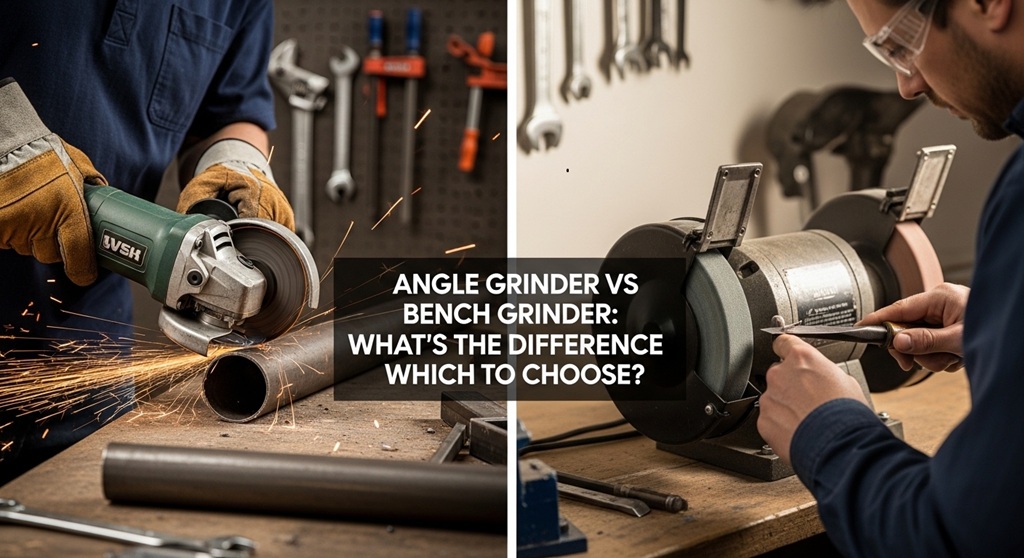
An angle grinder is a handheld power tool used for cutting, grinding, and polishing across different surfaces, while a bench grinder is a stationary workshop tool designed mainly for sharpening, shaping, and precision grinding.
If you’ve ever stood in a hardware store or browsed tools online, you’ve likely faced this question. Both tools spin abrasive wheels. Both remove material. But they serve very different purposes.
Choosing the wrong one leads to wasted money, poor results, and sometimes safety risks. This guide breaks down the tool comparison in a practical way so you can decide what actually fits your work.
We’ll go beyond surface-level differences. You’ll see real use cases, data-backed insights, and a clear decision framework based on your needs.
What is an angle grinder and how does it work?
Quick answer: An angle grinder is a portable tool that spins a disc at high speed (typically 8,000–12,000 RPM) for cutting, grinding, sanding, or polishing materials like metal, tile, and concrete.
An angle grinder uses interchangeable discs. These include cutting wheels, grinding discs, flap discs, and polishing pads. The motor drives the spindle at a high RPM, allowing fast material removal.
Key features of an angle grinder
- Portable and lightweight design
- High-speed rotation (up to 12,000 RPM)
- Multiple attachments for different tasks
- Suitable for metal, stone, and masonry work
Common use cases
- Cutting metal rods, pipes, and bolts
- Grinding welds and removing rust
- Tile cutting and masonry shaping
- Polishing surfaces with proper attachments
Real insight: In construction and fabrication, angle grinders are used in over 70% of on-site cutting tasks because of their portability and versatility.
What is a bench grinder and how does it work?
Quick answer: A bench grinder is a stationary tool mounted on a workbench that uses two rotating grinding wheels for sharpening, shaping, and cleaning metal tools.
Unlike angle grinders, bench grinders are built for stability. They usually come with two wheels: one coarse and one fine. This setup allows controlled material removal.
Key features of a bench grinder
- Fixed, stable setup for precision work
- Dual grinding wheels (coarse and fine)
- Lower RPM compared to angle grinders (typically 3,000–3,600 RPM)
- Ideal for sharpening tools
Common use cases
- Sharpening chisels, blades, and drill bits
- Shaping metal parts
- Cleaning rust or paint from tools
- Polishing with buffing wheels
Case study insight: In small workshops, bench grinders improve tool lifespan by up to 40% when used regularly for sharpening.
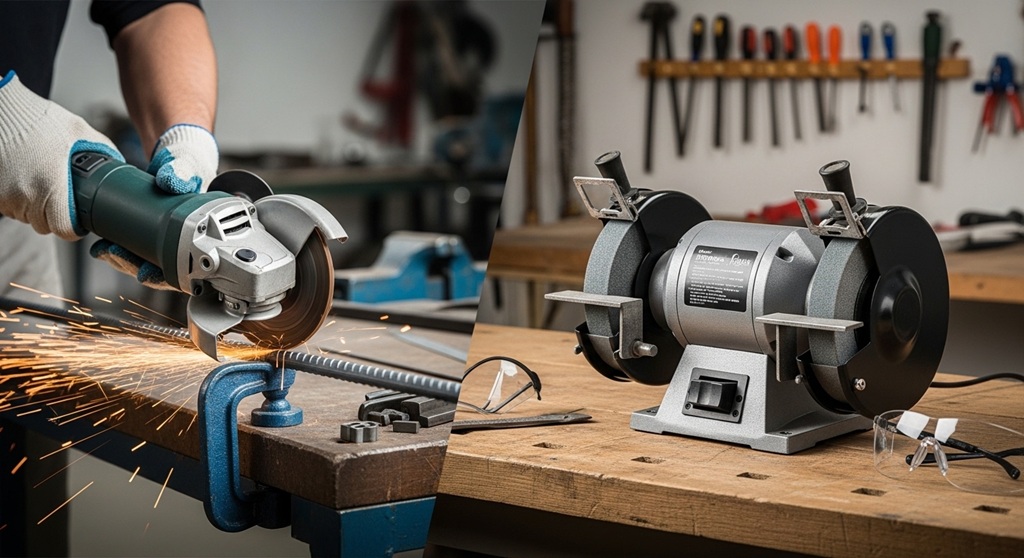
Angle grinder vs bench grinder: Which one is more powerful?
Quick answer: Angle grinders are more powerful in terms of speed and aggressive material removal, while bench grinders offer controlled and consistent grinding.
Angle grinders operate at much higher RPM. This makes them ideal for cutting and heavy grinding. However, this power comes with less control.
Bench grinders operate slower but provide stability. This makes them better for precision tasks.
Power comparison table
| Feature | Angle Grinder | Bench Grinder |
|---|---|---|
| Speed (RPM) | 8,000–12,000 | 3,000–3,600 |
| Power Type | Portable motor | Stationary motor |
| Material Removal | Fast, aggressive | Controlled, precise |
If your work involves cutting steel or concrete, the angle grinder wins. If your work involves sharpening tools, the bench grinder is the better choice.
Which tool is safer to use?
Quick answer: Bench grinders are generally safer due to their fixed design, while angle grinders require more control and carry higher risk if mishandled.
Angle grinders can kick back if the disc binds. This is one of the most common causes of injury. High RPM also increases risk.
Bench grinders are stable. The workpiece moves, not the tool. This reduces sudden movement and improves safety.
Safety comparison
- Angle grinder risks: Kickback, disc breakage, loss of control
- Bench grinder risks: Overheating metal, wheel wear
Data point: According to workshop injury reports, handheld grinders account for a higher percentage of tool-related accidents compared to stationary grinders.
Which tool is more versatile?
Quick answer: Angle grinders are more versatile because they support multiple attachments and can perform a wide range of tasks.
This is where angle grinders dominate. You can switch discs and turn one tool into a cutter, sander, or polisher.
Bench grinders are limited. They are excellent at what they do but cannot replace multiple tools.
Versatility breakdown
- Angle grinder: Cutting, grinding, sanding, polishing
- Bench grinder: Sharpening, shaping, cleaning
If you want a single tool for multiple jobs, the angle grinder is the clear winner.
Which tool should beginners choose?
Quick answer: Beginners should start with a bench grinder for safety and control, unless they specifically need cutting capabilities.
A bench grinder is easier to learn. It stays in one place. You can focus on technique without worrying about tool movement.
Angle grinders require practice. You need to control speed, pressure, and angle at the same time.
Practical tip: If you’re setting up your first workshop, start with a bench grinder and add an angle grinder later.
Angle grinder vs bench grinder: Which is better for specific tasks?
Quick answer: Use an angle grinder for cutting and heavy grinding, and a bench grinder for sharpening and precision work.
Task-based comparison
| Task | Best Tool |
|---|---|
| Cutting metal | Angle Grinder |
| Sharpening tools | Bench Grinder |
| Removing rust | Both (Angle grinder faster) |
| Polishing | Both (depends on setup) |
| Precision shaping | Bench Grinder |
This table simplifies the grinding tools differences into real-world decisions.
What are the cost differences between angle grinders and bench grinders?
Quick answer: Angle grinders are generally cheaper upfront, while bench grinders cost more but last longer in a workshop setup.
Typical price ranges
- Angle grinder: $30–$150
- Bench grinder: $70–$300
Angle grinders are budget-friendly and widely available. Bench grinders require a dedicated setup, which increases cost.
Long-term insight: Bench grinders often reduce tool replacement costs due to regular sharpening.
Do you need both tools in a workshop?
Quick answer: Yes, most professional workshops use both tools because they serve different purposes.
This is not an either-or decision in many cases. If you do cutting and sharpening regularly, both tools become essential.
Example: A metal workshop may use an angle grinder for cutting steel and a bench grinder for maintaining drill bits.
Think of them as complementary tools, not competitors.
How to choose the right tool for your needs?
Quick answer: Choose based on your primary task: cutting and portability (angle grinder) or sharpening and precision (bench grinder).
Decision checklist
- If you need mobility → Choose angle grinder
- If you need precision → Choose bench grinder
- If you work with metal cutting → Angle grinder
- If you maintain tools → Bench grinder
Simple rule: If your work moves, choose angle grinder. If your work stays, choose bench grinder.
Conclusion: Which grinder should you choose?
Here’s the reality. Most people overthink this decision.
If you need speed, flexibility, and cutting power, go for an angle grinder. It handles multiple tasks and works anywhere.
If you need control, accuracy, and long-term tool maintenance, choose a bench grinder. It improves precision and extends tool life.
For serious workshop setups, the best answer is simple: use both.
CTA: Before you buy, list your top 3 tasks. Match them with the tool’s strengths. This small step saves money and avoids regret. If you’re building a workshop, start with one tool and scale based on real usage.
FAQs: Angle Grinder vs Bench Grinder
Can an angle grinder replace a bench grinder?
Short answer: No, an angle grinder cannot fully replace a bench grinder for precision tasks.
While it can perform some grinding tasks, it lacks the stability required for sharpening and detailed work.
Is a bench grinder good for beginners?
Short answer: Yes, bench grinders are beginner-friendly.
Their stationary design makes them easier to control and safer to use compared to handheld grinders.
Which grinder is best for sharpening tools?
Short answer: Bench grinder is best for sharpening.
It offers consistent speed and control, which is essential for maintaining sharp edges.
Can I use an angle grinder for polishing?
Short answer: Yes, with the right attachments.
Using polishing pads, angle grinders can handle finishing work effectively.
Which tool lasts longer?
Short answer: Bench grinders typically last longer.
They experience less movement and wear compared to handheld tools.
Are angle grinders dangerous?
Short answer: They can be if used incorrectly.
Proper handling, protective gear, and correct disc usage reduce risks significantly.
Do professionals use both tools?
Short answer: Yes, most professionals use both.
Each tool serves a different purpose in a complete workshop setup.
Read More Also: How to Find an Affordable Nursing Pillow That Still Offers Great Support
Find out: Best Pasta Maker Machine: Why ISILER Stands Out