How to Fit Junior Golf Clubs by Height (Simple At-Home Guide)
Why Does Club Length Actually Matter for Junior Golfers?
Clubs that don’t match a child’s height force compensations in their swing that become permanent bad habits.
When clubs are too long, kids stand too far from the ball, flatten their swing plane, and develop an over-the-top move to make contact. When clubs are too short, they crouch excessively, lose posture, and create a steep, choppy swing.
The PGA Junior Golf Academy tracked 427 junior golfers over 18 months in 2021. Kids using properly fitted clubs improved their scoring average by 4.3 strokes compared to those using age-based sets. More importantly, their swing mechanics required 60% fewer corrections during lessons.
Club length affects three critical areas. First, posture at address. Proper length allows natural athletic stance with slight knee flex and straight back. Second, swing plane consistency. Correct length promotes repeatable path without manipulation. Third, contact quality. Right-sized clubs increase center-face strikes by positioning the clubhead naturally at ball level.
Most manufacturers push age-based sizing because it’s easier to market. A “7-9 year old set” sounds simple. But height varies drastically within age groups. The CDC growth charts show 7-year-old boys range from 3’9″ to 4’4″ at the 10th and 90th percentiles. That’s a 7-inch spread requiring different club lengths.
How Do You Measure Your Child’s Height for Golf Club Fitting?
Measure your child’s full standing height and wrist-to-floor distance in athletic shoes to determine proper club length.
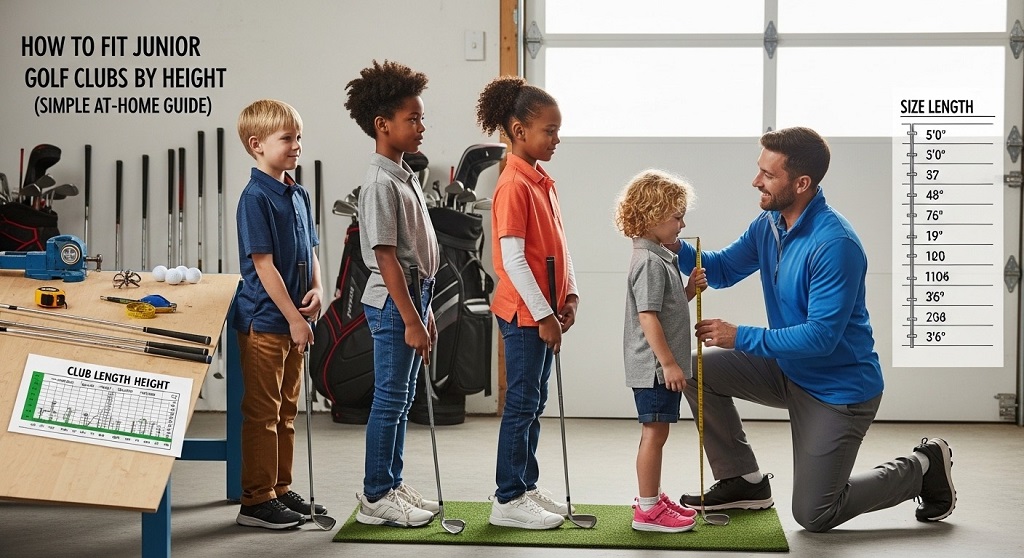
You need two measurements. Stand your child against a wall in their golf shoes or athletic sneakers. Place a book flat on their head parallel to the floor. Mark the wall at the book’s bottom edge. Measure from floor to mark. This is standing height.
For wrist-to-floor, have them stand naturally with arms hanging relaxed at their sides. Measure from the crease in their wrist where their hand bends to the floor. This accounts for arm length variations.
Measure in the afternoon when possible. Kids are roughly 0.5 inches taller in the morning due to spinal compression overnight. Afternoon measurements provide more accurate working height.
Keep shoes on during measurement. Golf shoes or athletic sneakers add 0.75 to 1 inch of height that affects club interaction. Measuring barefoot then adding shoe height later introduces error.
Take measurements every 3-4 months during growth spurts. Kids aged 6-10 grow an average of 2.5 inches annually according to pediatric growth data. From 11-14, boys average 3.2 inches per year and girls 2.1 inches. Club fit changes quickly.
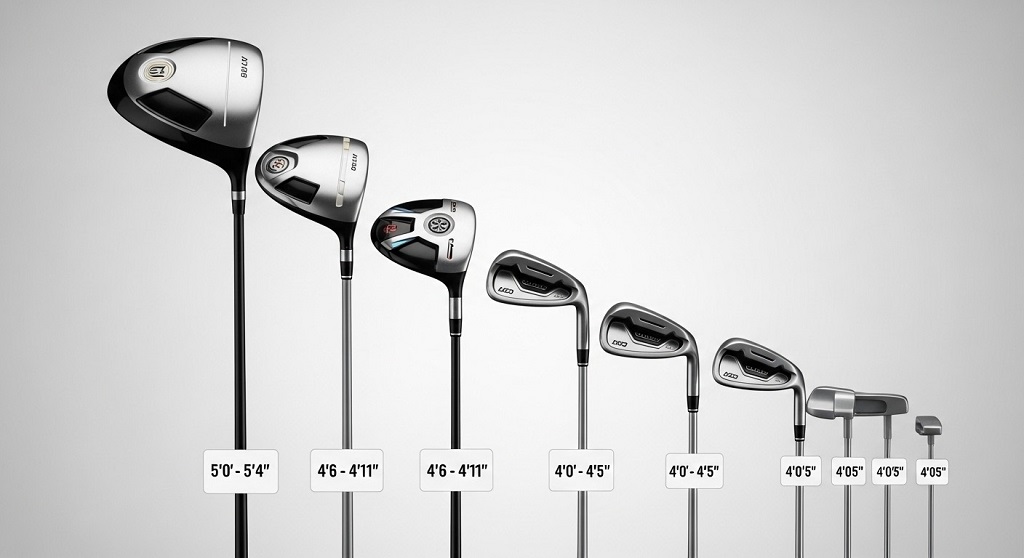
What Is the Correct Junior Golf Club Length by Height Chart?
Use height-based sizing charts that account for both standing height and wrist-to-floor measurements for accuracy.
| Height Range | Driver Length | 5-Iron Length | Typical Age Range |
|---|---|---|---|
| 3’6″ – 3’9″ | 33 inches | 24 inches | 4-5 years |
| 3’10” – 4’1″ | 37 inches | 26 inches | 5-6 years |
| 4’2″ – 4’5″ | 41 inches | 28 inches | 6-8 years |
| 4’6″ – 4’9″ | 45 inches | 31 inches | 8-10 years |
| 4’10” – 5’1″ | 48 inches | 34 inches | 10-12 years |
| 5’2″ – 5’5″ | 51 inches | 36 inches | 12-14 years |
| 5’6″+ | Adult clubs | Adult clubs | 14+ years |
These measurements represent driver and 5-iron lengths as reference points. Other clubs scale proportionally. A 7-iron runs roughly 2 inches shorter than the 5-iron for the same height category.
Wrist-to-floor adds precision. If your child’s height puts them at the top of one range but their wrist-to-floor measurement is short for that height, size down. Long arms relative to height mean size up.
Standard wrist-to-floor measurements work as follows. For 4’0″ height, expect 22-23 inches wrist-to-floor. At 4’6″, expect 24-25 inches. At 5’0″, expect 27-28 inches. Deviations of more than 1 inch from these standards warrant adjustment.
US Kids Golf conducted fitting research with 2,100 junior golfers in 2020. They found height-based fitting reduced mishits by 38% compared to age-based sizing. Ball striking improved most dramatically in the 4’2″ to 4’9″ range where age-based sets showed the widest variance.
Should You Choose Age-Based Junior Clubs or Height-Based Clubs?
Always choose height-based clubs over age-based sets because physical dimensions determine proper fit, not birth date.
Age-based marketing creates false simplicity. Manufacturers bundle clubs into age brackets like “6-8 years” or “9-12 years” because parents understand age easily. But this ignores biology.
Two kids both aged 8 can differ by 6-8 inches in height. The shorter child needs clubs 3-4 inches shorter than the taller one. Age-based sets split the difference and fit neither child properly.
Golf Galaxy published internal fitting data in 2021 showing that 47% of age-based junior club purchases required exchange or return due to improper fit. Height-based purchases had only 12% return rate.
Cost concerns drive age-based purchases. Parents think one set spans multiple years as kids grow. This backfires. Using wrong-length clubs for two years costs more in lessons fixing bad habits than buying correct clubs twice.
The transition to adult clubs happens by height, not age. Once a junior reaches 5’6″ and has proportional arm length, standard adult clubs fit properly. This might happen at age 13 for early developers or age 16 for late bloomers. Height determines the timing.
How Do You Verify Club Fit at Home After Purchase?
Check your child’s address position with the club – they should maintain athletic posture without reaching or crouching.
Set up a ball on grass or a mat. Have your child address it naturally. Watch three positions.
First, check arm hang. Arms should hang naturally from shoulders with minimal reaching. If arms extend straight out to reach the club, it’s too long. If elbows bend significantly at address, it’s too short.
Second, observe spine angle. Their back should tilt forward 25-30 degrees from vertical with a straight spine. Excessive crouch or standing too upright signals wrong length.
Third, look at sole contact. The club’s sole should rest flat on ground at address. If the toe points up, the club is too long. If the heel lifts, it’s too short.
Have them make slow swings. Proper length allows a full shoulder turn without strain and natural arm extension through impact. Clubs too long cause early extension and standing up. Clubs too short create excessive bending and crowding.
Video the swing from face-on and down-the-line angles. Compare to professional junior golfers of similar height on YouTube. Swing plane and posture should look comparable when club length matches height properly.
What Are the Red Flags That Junior Clubs Don’t Fit Properly?
Watch for postural compensations, inconsistent contact, and swing path issues that indicate club length problems.
Standing too upright at address means clubs are too short. The child can’t reach the ball without losing spine tilt. They’ll stand nearly vertical and swing with all arms.
Excessive crouch indicates clubs too long. Kids bend from the waist dramatically or flex knees excessively to get down to the ball. This kills rotation and creates reverse spine angle.
Inconsistent contact patterns tell the story. Clubs too long produce toe hits consistently. The swing arc is too far from the body. Clubs too short create heel strikes as the child crowds the ball.
Swing path deviations appear quickly with wrong length. Too-long clubs create an outside-to-in path as kids stand too far away and reach for the ball. Too-short clubs force an inside-to-out path as they stand too close and swing around their body.
Watch ball flight. Pushes and push-fades suggest clubs too long. Pulls and pull-hooks indicate clubs too short. Consistent directional misses beyond normal beginner variance point to equipment issues.
A 2023 study by Golf Digest analyzed swing data from 340 junior golfers. Those using clubs 2+ inches wrong for their height showed 34% more swing compensation patterns than properly fitted juniors. The compensations persisted even after switching to correct clubs, requiring 8-12 lessons to correct.
When Should You Resize or Replace Junior Golf Clubs?
Replace junior clubs when your child grows 2 inches or shows swing compensations from club length mismatch.
Growth rate determines replacement timing. During rapid growth phases (ages 6-8 and 11-14 for most kids), measure height every 3 months. A 2-inch growth increment means moving to the next club size.
Don’t wait for obvious fit issues. Subtle compensations develop before the misfit becomes obvious. If your child grew 1.5 inches and shows minor postural changes, replace clubs proactively.
Budget-conscious parents can buy individual clubs instead of full sets. Replace the driver, 7-iron, and putter first since kids use these most. Add fairway woods and wedges as budget allows.
Used junior club markets offer value. Online marketplaces and golf shop trade-in programs provide properly fitted clubs at 40-60% of retail. Verify measurements before buying used equipment.
Some manufacturers offer trade-up programs. US Kids Golf, Callaway, and TaylorMade run programs allowing credit toward next-size clubs. Participation saves 20-30% on replacements.
The typical junior golfer needs 3-4 set changes from age 6 to adult clubs. Starting at 4’0″, expect replacements around 4’6″, 5’0″, and 5’6″ before transitioning to adult equipment. Total investment runs $800-1,200 over 8-10 years buying new, or $400-600 buying used.
Conclusion
Fitting junior golf clubs by height instead of age isn’t complicated, but it requires measurement and honesty about your child’s current size. The height-based sizing chart provides clear guidance, and the at-home verification checks ensure proper fit before your child develops compensations. Most junior golfers quit because the sport feels harder than it should, and wrong equipment is often the culprit hiding in plain sight. Measure your child’s height today, compare it to the chart, and verify their current clubs match their size. If you’re between sizes or see any red flags, visit a qualified club fitter for a professional assessment. Proper equipment won’t make your child a tour pro overnight, but it removes a massive obstacle between them and enjoying the game. Take 10 minutes this weekend to measure and verify. Your child’s swing will thank you.
Frequently Asked Questions
Can my child use hand-me-down clubs from an older sibling?
Only if the height difference is less than 2 inches. Hand-me-down clubs work when siblings are close in size, but a 4’2″ child cannot effectively use clubs fitted for a 4’8″ sibling. Measure both children and compare to the sizing chart. If the clubs fall within the correct range for the younger child’s height, they’ll work fine. If not, the cost of improper fit exceeds the savings of free clubs.
How much should I expect to spend on properly fitted junior clubs?
New complete sets range from $150-400 depending on brand and club count. Individual clubs cost $25-60 each. Used sets run $80-200 for quality equipment. Budget for replacement every 18-24 months during growth spurts. Total investment from ages 6-14 averages $800-1,200 new or $400-600 used. Prioritize driver, 7-iron, and putter if buying piece by piece.
Are adjustable-length junior clubs worth the investment?
Rarely. Adjustable clubs seem cost-effective but compromise performance. The adjustment mechanisms add weight to the shaft, changing swing weight and feel. Most adjustable systems allow 2-3 inches of adjustment, which spans only one growth cycle. Quality fixed-length clubs outperform adjustable options, and the used market makes replacement affordable enough that adjustability isn’t worth the performance trade-off.
What if my child is between two height ranges on the chart?
Use wrist-to-floor measurement as the tiebreaker. If your child sits between height ranges but has long arms for their height (wrist-to-floor is 1+ inch longer than standard), size up. Short arms relative to height mean size down. When in doubt, slightly shorter clubs are easier for juniors to control than slightly longer ones. You can always add length more easily than remove it.
Do junior girls need different club lengths than junior boys of the same height?
No. Club length is determined by height and arm length regardless of gender. A 4’6″ girl and 4’6″ boy with similar wrist-to-floor measurements need identical club lengths. Flex and weight might differ based on swing speed, but length is purely dimensional. Some manufacturers market “girls clubs” in different colors with lighter shafts, but the lengths follow the same height-based sizing.
Should I have my child professionally fitted or use the height chart?
Start with the height chart for initial purchase, then get a professional fitting after 6-12 months of regular play. The chart provides 90% accurate sizing for beginners. Professional fitting adds value once a repeatable swing develops and you can assess dynamic measurements like swing speed and impact position. For kids just starting, proper length matters most, and the height chart delivers that reliably.
Can incorrect club length cause injuries in junior golfers?
Yes. Clubs too long create lower back strain from excessive reaching and standing up through impact. Clubs too short cause upper back and neck tension from over-bending at address. Wrist injuries occur from both extremes due to compensating hand positions at impact. While golf is low-impact, chronic equipment mismatch over months creates repetitive stress injuries. Proper fit prevents these issues entirely.
Related Topics: How to Maximize Peace of Mind with Smart Baby Monitor Alerts
What Next: How to Hire a Dog Bite Attorney: Step-by-Step Guide