
How to Follow a Smart Golf Clubs Buying Guide in 2026
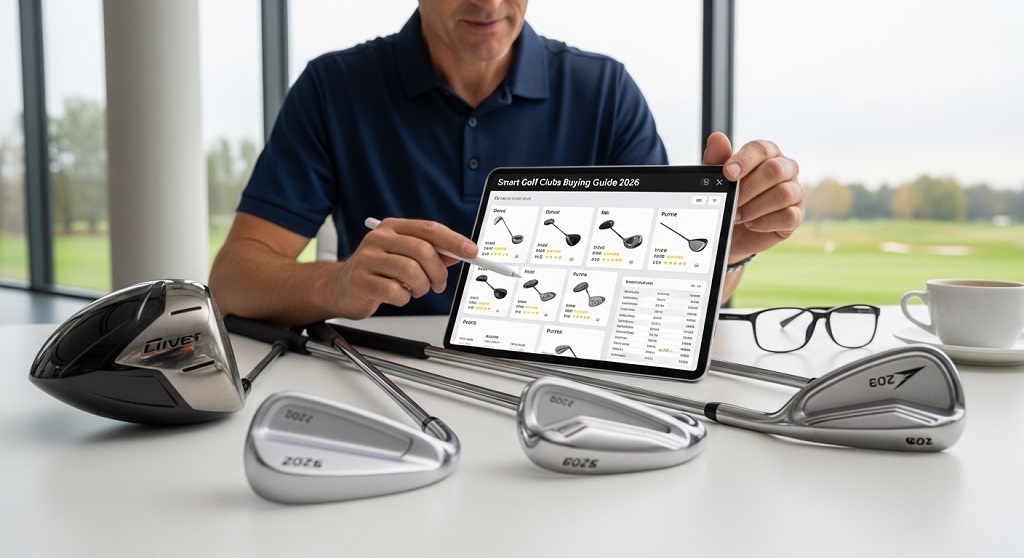
What is a smart golf clubs buying guide in 2026?
A smart golf clubs buying guide in 2026 helps golfers choose equipment based on skill level, swing data, forgiveness needs, and technology compatibility instead of brand hype or price alone.
Buying golf clubs today is different from even five years ago. Adjustable drivers, AI-designed faces, hybrid replacements for long irons, and launch-monitor-based fittings have changed how golfers build a bag. Yet many players still choose clubs based on appearance or marketing claims. That leads to wasted money and slower improvement.
According to USGA handicap tracking trends, most amateur golfers score above 90. That means forgiveness and consistency matter more than distance. A structured buying process prevents common mistakes and helps match clubs to actual performance needs.
This guide explains how to select the right clubs step by step using modern fitting logic, real performance data principles, and practical buying strategies. Whether you are a beginner building your first set or an experienced golfer upgrading equipment in 2026, this article shows how to choose smarter and play better.
Why do most golfers choose the wrong clubs?
Most golfers choose the wrong clubs because they prioritize brand reputation, tour-player usage, or distance claims instead of swing characteristics and consistency needs.
Problem: Many golfers assume professionals use the “best” equipment for everyone. But tour players swing faster and strike more consistently than amateurs.
Agitation: That mismatch creates common issues:
- Loss of accuracy
- Lower launch angles
- Reduced carry distance
- Higher dispersion
- Lower confidence at address
Solution: A structured golf clubs buying guide focuses on forgiveness, shaft fit, and launch conditions instead of marketing labels.
Independent fitting studies show properly fitted clubs can improve accuracy by up to 20% compared to off-the-shelf equipment. That improvement affects scoring more than distance gains.

How should beginners choose golf clubs in 2026?
Beginners should choose cavity-back irons, hybrid replacements, lightweight shafts, and forgiving drivers with higher loft between 10.5° and 12°.
A beginner-friendly set improves learning speed and reduces frustration early in the game.
Recommended beginner setup:
- Driver with adjustable loft
- Fairway wood (5-wood preferred)
- Hybrid instead of long irons
- Cavity-back irons (6–PW)
- Sand wedge
- Blade-style putter or mallet putter
Game-improvement irons remain the most effective choice for players shooting above 95. Their perimeter weighting increases stability during off-center strikes.
Modern hybrids also launch higher than traditional 3-irons. Launch monitor testing consistently shows hybrids increase carry distance for amateur golfers.
What factors matter most when buying golf clubs?
The most important factors include skill level, swing speed, shaft flex, forgiveness rating, and launch characteristics.
| Factor | Why It Matters |
|---|---|
| Swing Speed | Determines shaft flex selection |
| Skill Level | Controls forgiveness requirement |
| Clubhead Design | Influences launch and spin |
| Shaft Material | Affects tempo and control |
| Loft Configuration | Optimizes distance gaps |
Ignoring even one of these variables leads to inconsistent results across the bag.
How does swing speed affect club selection?
Swing speed determines shaft flex, driver loft, and clubhead type for optimal distance and accuracy.
Typical driver swing speed categories:
- Below 85 mph → Senior flex
- 85–95 mph → Regular flex
- 95–105 mph → Stiff flex
- Above 105 mph → Extra stiff flex
Players using shafts that are too stiff often lose launch height. Players using shafts that are too soft lose directional control.
Modern fitting sessions confirm shaft mismatch is one of the biggest causes of inconsistent ball flight.
Should golfers buy a full set or individual clubs?
Beginners benefit more from complete sets, while intermediate golfers should build custom combinations based on performance gaps.
Complete sets offer:
- Lower total cost
- Consistent shaft design
- Balanced loft progression
- Faster learning curve
However, intermediate players often replace:
- Long irons with hybrids
- Stock drivers with adjustable models
- Standard wedges with specialty wedges
This modular approach improves scoring efficiency.
Why are hybrids replacing long irons in modern golf bags?
Hybrids are easier to launch, more forgiving, and more consistent from rough compared to long irons.
Launch monitor testing shows most amateur golfers hit hybrids higher and farther than equivalent long irons.
Typical replacements include:
- 3-iron → 19° hybrid
- 4-iron → 22° hybrid
- 5-iron → 25° hybrid
This change improves approach-shot accuracy from 180+ yards.
How important is custom fitting in a golf clubs buying guide?
Custom fitting improves distance consistency, launch angle control, and shot dispersion across the entire set.
A 2023 fitting industry study found golfers gained an average of 7–12 yards with properly fitted drivers compared to retail stock options.
Custom fitting adjusts:
- Shaft length
- Shaft flex
- Lie angle
- Grip thickness
- Loft settings
These adjustments improve contact quality and confidence.
What driver features should golfers prioritize in 2026?
Golfers should prioritize forgiveness, adjustable weighting, and optimized launch conditions instead of maximum advertised distance.
Modern drivers now include:
- Carbon crowns
- Sliding weight systems
- AI-designed faces
- Adjustable hosels
These technologies help correct slice bias and increase ball speed across the face.
Higher launch drivers often outperform low-spin tour models for amateur players.
How do irons affect scoring performance?
Irons influence approach accuracy, distance control, and greens-in-regulation percentage.
Game-improvement irons provide:
- Higher launch angles
- Larger sweet spots
- More perimeter weighting
- Reduced side spin
Players hitting fewer than 6 greens per round typically benefit most from cavity-back designs.
Which wedges should be included in a modern golf bag?
A balanced wedge setup includes pitching wedge, gap wedge, sand wedge, and lob wedge for distance spacing and short-game control.
Typical loft configuration:
- Pitching wedge → 44°–46°
- Gap wedge → 50°–52°
- Sand wedge → 54°–56°
- Lob wedge → 58°–60°
This structure prevents distance overlap inside 120 yards.
How important is putter selection when buying golf clubs?
Putter selection affects alignment confidence and stroke consistency more than any other club in the bag.
Golfers use putters on nearly 40% of total strokes during a round.
Two primary styles:
- Mallet putters improve alignment stability
- Blade putters improve feel and control
Stroke type determines the correct choice.
Should golfers choose steel or graphite shafts?
Steel shafts provide control and consistency, while graphite shafts increase swing speed and reduce vibration.
Graphite shafts are recommended for:
- Beginners
- Senior players
- Players with slower swing speeds
Steel shafts remain popular among mid-handicap golfers seeking accuracy.
What role does club forgiveness play in performance improvement?
Forgiveness helps maintain ball speed and direction on off-center strikes.
Most amateur golfers miss the center of the clubface frequently. High-MOI clubheads reduce penalty from those misses.
Forgiving clubs produce:
- Higher launch
- Straighter shots
- More consistent carry distances
That leads directly to lower scores.
How should golfers set a budget for buying clubs in 2026?
Golfers should prioritize driver, irons, and wedges first, then upgrade fairway woods and hybrids later if needed.
Suggested budget allocation:
| Club Category | Priority Level |
|---|---|
| Driver | High |
| Irons | High |
| Wedges | Medium |
| Hybrids | Medium |
| Putter | Personal Preference |
This strategy maximizes performance return per dollar spent.
What mistakes should golfers avoid when buying clubs?
Golfers should avoid choosing clubs based only on brand popularity, appearance, or professional endorsements.
Common mistakes include:
- Ignoring shaft flex
- Buying blades too early
- Skipping fitting sessions
- Choosing low-loft drivers
- Duplicating wedge loft gaps
Correcting these errors improves equipment efficiency immediately.
How can launch monitor data improve club selection decisions?
Launch monitor data provides measurable insights into ball speed, spin rate, launch angle, and carry distance.
Important metrics include:
- Ball speed
- Launch angle
- Spin rate
- Carry distance
- Dispersion pattern
These numbers help golfers select clubs based on evidence instead of guesswork.
Conclusion: How can golfers confidently follow a smart golf clubs buying guide in 2026?
A smart golf clubs buying guide in 2026 focuses on performance data, forgiveness needs, and swing compatibility instead of marketing claims.
Most golfers improve faster when they choose clubs matched to their swing speed, launch conditions, and scoring weaknesses. Hybrids replace difficult long irons. Adjustable drivers improve accuracy. Proper wedge spacing lowers short-game errors. Custom fitting increases consistency across every shot.
These changes do not require professional-level skill. They require structured decision-making.
If you are planning to upgrade your equipment this season, start by evaluating your swing speed, handicap range, and distance gaps. Then test clubs using launch monitor feedback whenever possible. A data-based selection strategy leads to better confidence and lower scores.
Ready to build a smarter golf bag for 2026? Use this guide as your checklist before your next equipment purchase and choose clubs that actually improve your performance on the course.
FAQs: Golf clubs buying guide in 2026
How often should golfers replace their clubs?
Most golfers should replace drivers every 4–6 years and irons every 6–8 years unless performance declines earlier. Groove wear and technology upgrades influence replacement timing.
Are expensive golf clubs always better?
No. Properly fitted mid-range clubs often outperform premium clubs that do not match swing characteristics. Fit matters more than price.
Do beginners need custom fitting?
Beginners benefit from basic fitting adjustments such as shaft flex and club length. Full advanced fitting becomes more useful after swing consistency improves.
What is the ideal number of wedges in a golf bag?
Most golfers perform best with three or four wedges spaced evenly by loft gaps of 4–6 degrees.
Should high handicappers use blade irons?
No. Blade irons require consistent center-face contact. High handicappers benefit more from cavity-back or game-improvement irons.
Is buying used golf clubs a smart option?
Yes. Many previous-generation clubs offer strong performance at lower cost. Ensure grooves and shafts remain in good condition before purchase.
What is the most important club to upgrade first?
The driver usually provides the largest performance improvement because it influences distance and positioning on every hole.
Read More Also: How to Make Handmade Wedding Cords for a Unique Ceremony
Discover More: How to Choose Diamond Alternatives for Engagement Rings