What to Look for in a Golf Cart for Hilly Golf Courses
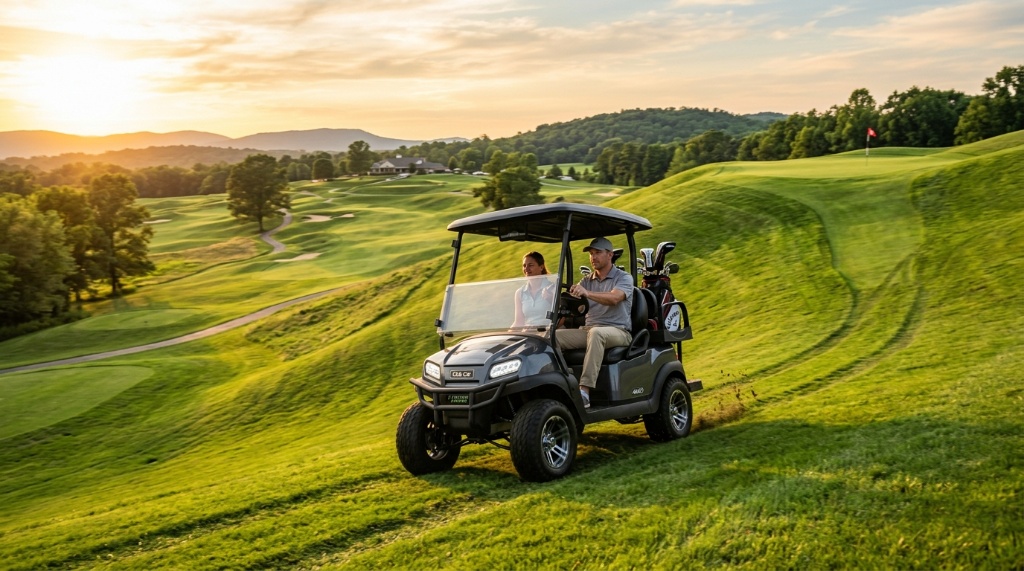
A par 4 that climbs sixty feet from tee to green plays differently when you’re hauling forty pounds of clubs and a battery up it. Golfers on flat layouts rarely think about cart design; golfers on ridge and mountain courses think about little else. The questions change — does the cart hold speed on a steep descent, does it resist tipping on a sidehill lie, does the battery survive eighteen holes of constant climbing? Looking closely at how someone approaches testing the MGI all-terrain electric caddy on rolling terrain is a useful way to see which features genuinely matter once the ground stops being flat.
Quick Answer
For hilly courses, prioritize four things in order: motor torque and gearing (not top speed), downhill braking control, wheel size and tread for traction, and battery capacity measured in watt-hours rather than marketing claims about “36 holes.” Stability on sidehill lies and total weight matter next. A cart that performs well on flat fairways can still stall on a 15% grade or run away on a wet descent, so test on actual slopes before buying.
Key Takeaways
- Torque and gearing determine whether a cart climbs a grade; top speed and flat-ground range tell you almost nothing about hill performance.
- Downhill braking is the most overlooked feature — a freewheeling cart on a steep slope becomes a runaway hazard, not a convenience.
- Battery range drops significantly on hilly terrain because climbing draws far more current than rolling on flat ground.
- Wider wheelbases and larger-diameter wheels improve both traction and resistance to tipping on sidehill lies.
- Match the cart type to the course: a riding cart solves hills entirely, but many hilly courses restrict where carts may travel.
Why Hills Rewrite the Rules of Cart Design
Gravity is the whole story. On flat ground, a golf cart mainly needs to roll smoothly and steer predictably. On a slope, three separate forces start working against you at once.
Going uphill, the motor or your legs must overcome the component of gravity pulling the load downhill — which grows with the steepness of the grade, not just the distance. Going downhill, that same force accelerates the cart, and if nothing controls it, the cart pushes you rather than following you. On a sidehill, the cart’s center of gravity shifts laterally, and a narrow wheelbase that felt perfectly stable on the fairway suddenly feels like it wants to tip.
This is why a cart that reviews well for flat parkland courses can be a poor choice for a course built into a hillside. The specifications that matter are different ones, If you are also gearing up for specific regional conditions, make sure to read our guide on best golf balls for a texas golfer.
Motor Torque and Gearing: The First Thing to Check
Look for a motor rated for grade climbing, not for distance. Two numbers describe a motor’s real-world usefulness on hills: continuous torque output and the gear reduction between the motor and the wheels. A high-revving motor with tall gearing will move a cart quickly across a flat fairway and bog down on a steep climb. A lower-speed, higher-torque setup with deeper gear reduction will climb steadily and hold speed on descents.
If the manufacturer publishes a maximum incline rating, treat it as an ideal-condition figure measured on dry, firm turf with a fresh battery. Real courses offer wet grass in the morning, loose sand in bunker surrounds, and grades that vary within a single hole. A reasonable rule: if the stated maximum incline is close to the steepest hill you actually play, you have no margin.
Dual-motor designs, where each rear wheel has its own drive, generally offer better traction on uneven ground because one wheel can keep pulling when the other loses grip. They also tend to cost more and add weight.
Wheels, Tread, and Traction on Real Terrain
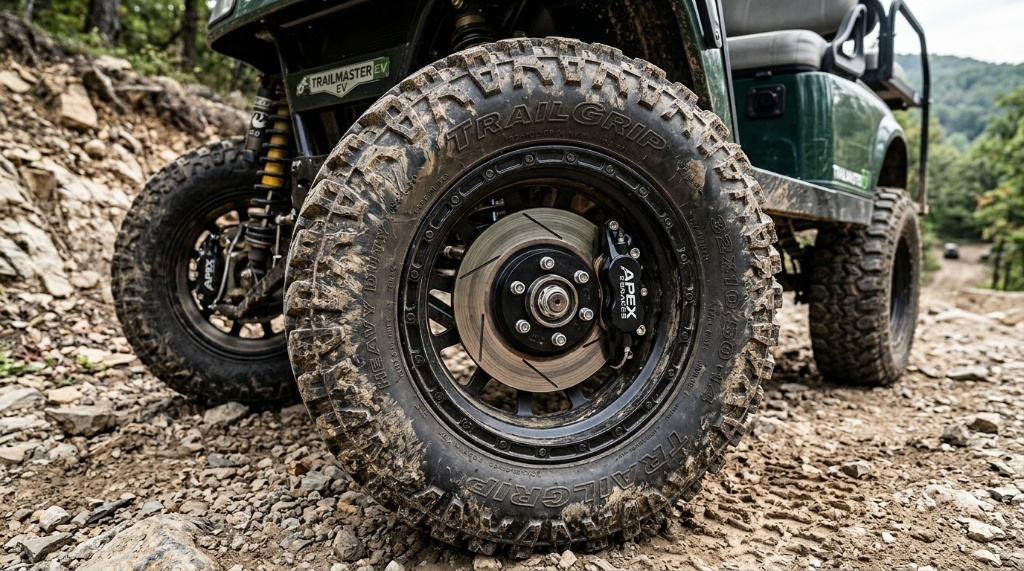
Wheel diameter and tread pattern do more for hill performance than most buyers expect. Larger-diameter wheels roll over uneven ground, roots, and small rocks instead of catching on them, and they distribute load over a longer contact patch. Wider, more aggressive tread bites into wet turf and loose gravel where a smooth, narrow tire spins.
There is a trade-off. Aggressive tread chews up soft turf and can leave visible tracks on fairways and greens surrounds, which some courses police strictly. If your home course is protective of its conditions, check what tread pattern is acceptable before buying.
Wheel configuration also matters:
- Three-wheel designs with a swiveling front wheel turn tightly and are easier to steer through narrow gaps, but they can feel less planted on fast descents.
- Four-wheel designs spread weight across a wider footprint, which improves stability on sidehills and braking traction on slopes, at the cost of maneuverability and folded size.
Downhill Braking: The Feature Most Buyers Ignore
On a steep descent, a freewheeling cart accelerates until something stops it — usually you, a bunker lip, or a pond. Electronic downhill braking, sometimes called descent control or speed limiting, holds the cart to a controlled pace rather than letting gravity take over. This is the single most important safety feature on a hilly course, and it is frequently absent from budget models.
Related features worth confirming:
- An emergency stop that engages immediately rather than requiring you to chase down a remote.
- A parking brake that holds on an incline when you stop to hit a shot, so the cart does not creep while your back is turned.
- A remote with a reliable range — on a hill, you may be sending commands from further away than you would on flat ground, and a dropped signal on a slope is genuinely dangerous.
If you walk hilly courses regularly, this is the area where spending more actually buys something measurable.
Battery Capacity and What “Range” Really Means on Slopes
Ignore the headline range figure. Climbing draws substantially more current than rolling on level ground, so a battery rated for a certain number of holes on flat terrain will deliver noticeably fewer on a course with continuous elevation change. The honest way to compare batteries is watt-hours (voltage multiplied by amp-hours), because that reflects total stored energy rather than a marketing estimate.
Two practical points:
- Lithium batteries are lighter, hold voltage more steadily as they discharge, and generally tolerate partial charging better. Lower weight also helps on climbs, since you are moving less mass uphill.
- Lead-acid batteries cost less upfront but weigh considerably more and tend to fade in cold weather, which matters for early-morning rounds in shoulder seasons.
If your course has a long, steep back nine, a spare battery or a mid-round charging option is worth planning for. Running out of charge at the bottom of a hill is a far worse problem than running out on flat ground.
Weight, Balance, and Sidehill Stability
A cart’s tipping resistance depends on how low and how central its center of gravity sits, and how wide its track is. Batteries mounted low and between the wheels help. Batteries mounted high or far forward hurt, especially on a sidehill lie where a lateral shift of a few inches is the difference between a stable cart and a fallen one.
Total weight cuts both ways. A lighter cart is easier to push if the battery dies and easier to lift into a vehicle, but it has less inertia to resist tipping and can feel skittish on rough descents. Heavier carts feel planted but are harder to manage when something goes wrong.
Also check how the cart behaves when you are not holding it. On a hilly course, you will frequently park it on a slope while you play a shot. A cart that needs to be perfectly level to stay put is a liability, If you are also gearing up for specific regional conditions, make sure to read our guide on the best golf balls for a texas golfer.
Push Cart vs. Electric Caddy vs. Riding Cart on Hills
The right answer depends on how steep your course is and whether walking is part of the point.
| Factor | Push cart | Electric caddy | Riding cart |
|---|---|---|---|
| Effort on climbs | High — you supply all the power | Low — motor does the work | None |
| Downhill control | You brake with your body | Depends on electronic braking; a key differentiator | Brake system built in |
| Traction on wet slopes | Limited by your footing | Varies widely by wheel and tread design | Generally strong |
| Stability on sidehills | You stabilize it | Depends on wheelbase and center of gravity | Highest |
| Transport and storage | Simplest | Folds; battery adds weight | Course-provided or trailer |
| Relative cost | Lowest | Middle to high | Highest |
| Best suited to | Gentle slopes, short walks | Steep courses where you still want to walk | Very steep courses, or when walking is impractical |
One constraint that overrides everything: course rules. Many hilly courses restrict riding carts to paths, require them to stay out of certain areas, or mandate a cart-path-only policy in wet conditions. Confirm what your course permits before you spend money on a solution you cannot use.
A Practical Checklist Before You Buy
- Measure your steepest regular hole. Use a phone level app or a course yardage book with elevation notes. Knowing whether your worst grade is 8% or 18% changes what you need.
- Confirm downhill braking exists. Ask specifically. “Does it hold speed on a descent?” is the question, not “does it have brakes?”
- Compare batteries in watt-hours, not in promised hole counts.
- Check wheel diameter and tread against your course’s turf rules.
- Test on a slope, not a parking lot. A flat demo tells you nothing about the feature you are buying for.
- Weigh the folded cart and battery if you load it into a car alone.
- Verify the course allows what you are buying before the return window closes.
Frequently Asked Questions
Is an electric golf caddy worth it on a hilly course?
Usually yes, if you want to keep walking. The motor removes the climbing effort, which is the main reason golfers stop walking hilly layouts. The caveat is that budget models without downhill braking can be less safe than pushing manually on steep descents.
Can a regular push cart handle steep hills?
It can, but the effort rises sharply with grade, and controlling a loaded push cart downhill on wet grass is genuinely difficult. Push carts make sense on gentle slopes and short walks. On sustained steep terrain, they become a physical strain rather than a convenience.
How much battery do I need for a hilly course?
There is no universal number, because it depends on the elevation change, the cart’s efficiency, and the temperature. As a general approach, choose a battery with more watt-hours than you think you need, and treat any flat-ground range claim as an optimistic ceiling rather than a guarantee.
Do I need a remote-controlled caddy on hills?
Not strictly, but remote control helps on hills because you can send the cart ahead or hold it back on a slope while you walk at your own pace. The more important feature is reliable braking, whether the cart is remote-controlled or not.
Will a golf cart tip over on a sidehill?
It can, particularly with a narrow wheelbase or a high-mounted battery. Four-wheel designs with a low center of gravity resist tipping better than narrow three-wheel designs. If your course has pronounced sidehill lies, treat stability as a primary buying criterion rather than an afterthought.
Are riding carts allowed on hilly courses?
Often, but with restrictions. Many hilly courses require carts to stay on paths, especially in wet conditions, and some limit them entirely in sensitive areas. Check the course policy before assuming a riding cart solves your problem.
Conclusion
Buying for hills means buying for torque, braking, and traction not for speed or a flattering range claim. Start by measuring the grades you actually play, then confirm that your shortlist has genuine downhill speed control, a battery sized in watt-hours, and wheels suited to your course’s turf rules. Test on a slope. If you walk, an electric caddy with real descent control is the practical choice; if the terrain is severe or walking is impractical, a riding cart is the honest answer. Either way, verify course rules before you commit.