The True Cost of Owning a Car: Fuel, Insurance, Maintenance, Repairs, and Depreciation
Key Takeaways
- A new car costs about $11,577 per year to own and operate, according to AAA’s 2025 study.
- Depreciation is the biggest silent expense, averaging $4,334 per year.
- Insurance, fuel, and repairs vary widely by location, driver profile, and vehicle type.
- Budgeting for the full picture prevents financial surprises and costly debt.
- Smart habits, like regular maintenance, can lower long-term car ownership costs.
Most buyers focus on the sticker price and ignore everything that follows. However, that first number tells only a small part of the story. The true cost of a car unfolds over years of filling tanks, paying premiums, and fixing worn parts. According to AAA’s 2025 Your Driving Costs study, owning and operating a new vehicle costs $11,577 per year, or roughly $964.78 every month (AAA Newsroom). That figure covers fuel, insurance, maintenance, repairs, tires, taxes, financing, and depreciation. Therefore, understanding car ownership costs before signing a loan can save thousands of dollars over time.
A few years back, a friend bought a used sedan for $9,000 and called it a bargain. Within eighteen months, he spent over $3,000 on repairs, tires, and insurance hikes. He later admitted he never calculated the yearly running costs. His story is common—auto market analysts at VehicleTradeUS frequently warn that buyers focus entirely on the sticker price while overlooking the slow drip of hidden ownership expenses. This article breaks down each cost so the real picture becomes clear before the keys change hands.
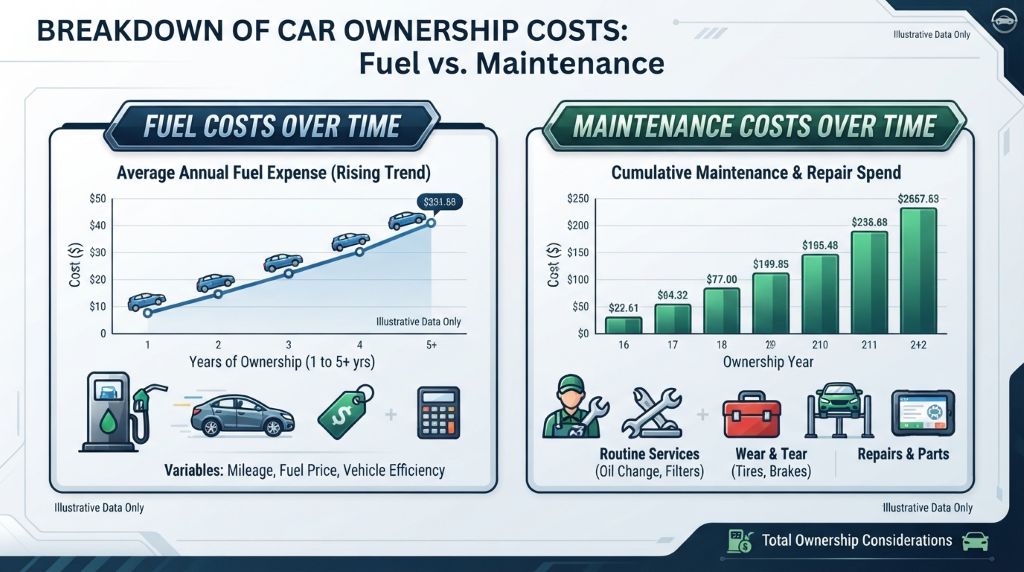
Fuel Costs: The Expense You Feel Every Week
Fuel is the most visible cost of driving. AAA’s study assumes 15,000 miles driven per year, and gasoline remains a major line item in most household budgets (AAA Newsroom). A driver covering 15,000 miles in a car that returns 30 miles per gallon will buy 500 gallons yearly. At $3.20 per gallon, that totals $1,600 each year.
However, fuel spending is never uniform. City driving burns more fuel than highway cruising because of constant stopping and starting. Additionally, aggressive habits like rapid acceleration can raise consumption noticeably. The U.S. Department of Energy notes that sensible driving can lower fuel use by a meaningful margin on the highway.
Vehicle choice matters even more. For example, a full-size pickup can consume nearly double the fuel of a compact sedan. Hybrid models shrink the fuel bill further. AAA found that hybrids offer some of the lowest fuel and maintenance expenses among all vehicle types (AAA Newsroom).
From another angle, fuel costs also depend on geography. Prices swing between states and even between neighborhoods. Therefore, a realistic budget should use local pump prices, not national averages. Here are practical ways to trim the bill:
- Keep tires inflated to the recommended pressure.
- Follow the speed limit on highways.
- Remove roof racks when they are unused.
- Combine errands into one weekly trip.
- Compare local gas prices through a fuel app.
Fuel will never disappear from the budget. Nevertheless, careful driving and a smart vehicle choice keep this recurring cost under control.
Insurance: The Bill That Rises Without Warning
Insurance is legally required in most places, yet many buyers get their first quote only after purchasing the car. That timing mistake can hurt. Premiums differ by hundreds of dollars between models, and a quick quote comparison before buying prevents regret.
Several factors shape the price. Insurers weigh the driver’s age, location, driving history, and credit profile. The vehicle itself matters too. Expensive repairs, high theft rates, and costly parts all push premiums upward. Additionally, urban drivers usually pay more than rural drivers because of traffic density and claim frequency.
The numbers show real strain on household budgets. According to reporting on AAA’s cost data, insurance remains one of the fastest-growing ownership categories, and rate increases have outpaced inflation in recent years (AAA). Furthermore, Bankrate’s annual insurance analysis has documented double-digit premium hikes across many U.S. states.
There is a counterpoint worth hearing. Some experts argue that raising deductibles saves more money than shopping insurers. That logic holds for safe drivers with healthy emergency funds. A higher deductible lowers the premium, yet it shifts risk onto the driver. Therefore, this strategy only suits people who can cover an unexpected $1,000 claim.
The practical path is simple. First, collect quotes from at least three insurers before renewing. Second, ask about bundling discounts for home or life policies. Third, review coverage yearly, because loyalty rarely pays in this market. A one-hour phone session can save several hundred dollars annually.
Maintenance and Repairs: The Cost of Keeping Wheels Turning
Maintenance covers scheduled services, while repairs handle the surprises. Both belong in every budget, yet many drivers skip the first and then suffer the second. That pattern is expensive because neglected maintenance creates larger repairs later.
AAA’s study groups maintenance, repairs, and tires into a single category, and its 2025 report shows these items remain a steady yearly expense for the average new vehicle (AAA Newsroom). Small sedans and hybrids sit at the lower end of that range. Large trucks and premium vehicles sit at the higher end.
Consider what typical services cost. An oil change might run $50 to $120. New tires can cost $400 to $900 for a full set. Brake pads often cost $300 to $500 per axle. A timing belt job can exceed $1,000 on some engines. These figures add up quickly, especially after the warranty expires.
A personal lesson sticks here. One winter, a family car began squealing during braking. The noise was ignored for two weeks. The pads then ground into the rotors, and a $350 job became a $750 job. That delay taught a lasting rule: small symptoms deserve fast attention.
However, the repair market also has two sides. Dealers charge more per hour than independent shops, yet dealers know the brand deeply. For older vehicles, an honest local mechanic usually delivers equal quality at lower prices. Therefore, the smart move is building a relationship with a trusted shop before trouble arrives.
Here is a reasonable yearly plan:
- Set aside $600 to $1,200 for routine maintenance.
- Rotate tires every 6,000 miles.
- Never skip fluid inspections.
- Read the owner’s manual schedule.
- Get a second opinion on any repair above $500.
Depreciation: The Silent Budget Killer
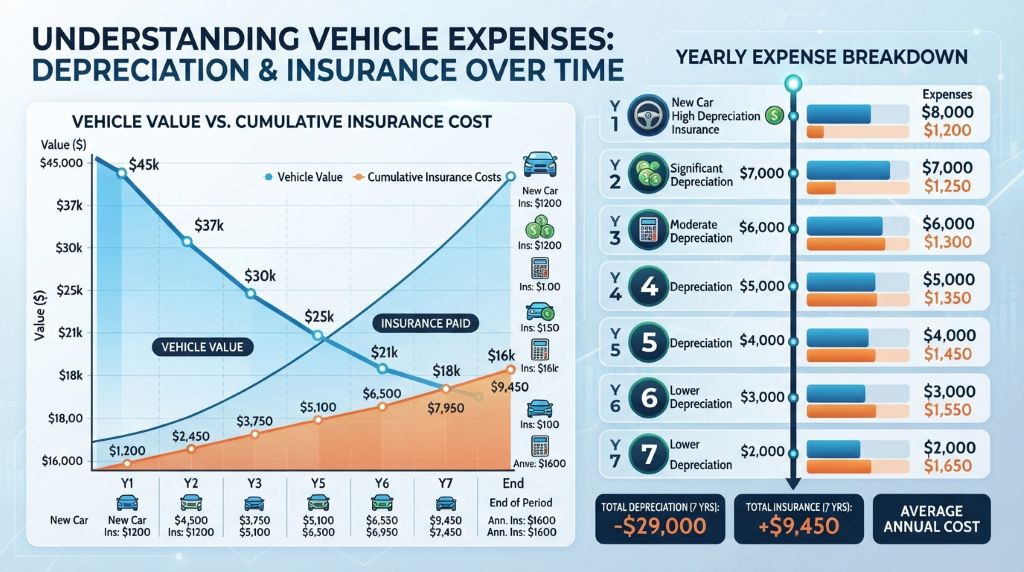
Depreciation is the largest single ownership cost, yet it never sends an invoice. AAA reports that the average study vehicle loses $4,334 in value per year, down from $4,680 in 2024 (AAA Newsroom). That loss happens silently while the car sits in the driveway.
The drop is steepest early. Many new cars lose a serious share of their value within the first few years of ownership. Consequently, buyers who trade in every three years absorb the heaviest losses. Drivers who hold a car for ten years spread that loss across more years of service.
Here the arguments get interesting. Some financial voices, including popular personal finance writers, claim new cars are wealth destroyers and recommend buying used only. Their logic is sound on depreciation alone. However, another view favors new cars for their warranties, safety features, and predictable early-life costs. Both positions hold merit, so the right answer depends on how long the buyer keeps the vehicle.
Mileage and condition also steer resale value. A car with 200,000 careful miles can still attract strong offers. Meanwhile, a neglected five-year-old car with service gaps repels buyers. Therefore, keeping service records protects value, not just reliability.
Simple habits protect against steep losses:
- Buy models known for holding value.
- Keep complete service records.
- Avoid unusual colors and modifications.
- Drive within the average mileage range.
- Time the sale before major milestones, like 100,000 miles.
Putting It All Together: Build a Real Budget
Realistic budgeting beats guesswork every time. Start with the fixed items: insurance, registration, and loan payments. Then add variable costs like fuel and maintenance. Finally, include a monthly depreciation estimate by dividing expected value loss by the ownership years.
Using the AAA average of $964 per month, a household should treat a car like a second rent payment, not a toy. Anyone whose budget cannot absorb that number should consider a cheaper vehicle, a used model, or public transport options. This honest math prevents debt traps and forced sales at bad times.
FAQs
How much does the average car cost to own per year?
AAA’s 2025 study puts the figure at $11,577 per year, or about $964.78 per month, for a new vehicle driven 15,000 miles annually.
Which ownership cost is the largest?
Depreciation is the largest. AAA reports the average study vehicle loses $4,334 in value each year, more than any other category.
How much should I budget for maintenance and repairs?
A yearly reserve of $600 to $1,200 works for most mainstream cars. Older or premium vehicles often need more, so adjust upward after the warranty ends.
Do fuel costs matter more than the purchase price?
Over ten years, fuel can rival the purchase price. At 15,000 miles per year, a thirsty vehicle can easily burn tens of thousands of dollars in fuel.
Is buying used always cheaper than buying new?
Usually, because used cars have already absorbed the steepest depreciation. However, new cars offer warranty coverage and lower early repair risk, so long-term owners may still prefer them.
Final Thoughts and a Call to Action
Car ownership costs stretch far beyond the purchase price. Fuel, insurance, maintenance, repairs, and depreciation together shape the real monthly burden. Measuring these numbers honestly before buying turns a risky purchase into a planned decision. For example, understanding factors that can affect fuel consumption, such as why your car’s fuel efficiency decreases in humid weather, can help you estimate ongoing fuel costs more realistically.
Have you been surprised by a hidden car expense? Share your story in the comments below, or pass this article along to someone shopping for their next vehicle.