Is the FunWater Inflatable SUP Worth It?

Stand-up paddleboarding has exploded in popularity, but the cost of a quality board can feel like a barrier to entry. If you’ve been searching for an affordable option that doesn’t look like a pool toy, you’ve probably stumbled across the FunWater brand. With a price point significantly lower than mainstream competitors, it naturally raises a big question: is it actually any good, or are you just throwing money into the water? This article takes a close, practical look at the FunWater inflatable SUP to help you decide if it’s the right board for your specific needs. We’ll break down its construction, real-world performance, and whether it genuinely delivers value, covering everything you need to know before making a purchase. By the end, you’ll know if this budget-friendly board is a smart investment or a compromise you’ll regret.
Key Takeaways
- The FunWater SUP is a legitimate budget option for absolute beginners and casual paddlers, but it’s not a direct substitute for premium boards from brands like Red Paddle or Blackfin.
- Its single-layer PVC construction means it’s less rigid than higher-end double-layer or woven-drop-stitch boards, which impacts performance in choppy water.
- You’re getting a complete package with accessories, but the quality of the included paddle and pump is a common area for future upgrades.
- While fine for calm lakes and slow rivers, this board’s width and soft deck make it less suitable for touring, speed, or intense yoga sessions.
- Proper inflation to the recommended PSI is not optional—it’s critical for preventing a “banana” bend and maximizing the board’s limited rigidity.
Understanding the FunWater Brand and Market Position
To answer the question of whether the FunWater is “worth it,” you first need to understand where it sits in the market. This is not a premium brand. Instead, FunWater operates in the highly competitive “budget to mid-range” category, often selling direct-to-consumer through online marketplaces. This business model allows them to drastically undercut the prices of established brands that rely on retail distribution networks and extensive marketing budgets. When you buy a FunWater board, you are primarily paying for the hardware (the PVC and drop-stitch material) and basic manufacturing, not the research and development that goes into high-performance designs. This is a crucial distinction that sets the expectations for what you get in the box. For more insights into how this brand performs in specific conditions, you might find this detailed funwater inflatable sup review useful, as it discusses its handling in diverse environments.
Construction and Material Quality: What Are You Actually Getting?
The most significant factor in an iSUP’s performance and longevity is its construction. The FunWater boards are typically constructed using a single-layer drop-stitch core with a PVC coating. This is the entry-level standard for the industry. In contrast, higher-end boards ($700+) usually feature dual-layer or woven drop-stitch technology, which creates a much stiffer platform when inflated. The stiffness of the board determines how much it flexes into a “taco” shape under your weight and the stress of paddling. A less rigid board absorbs your stroke energy and makes the water feel sloppier, forcing you to work harder to maintain a straight line.
The “Banana” Effect
One of the most common complaints about single-layer boards is the tendency for the nose to bend upward over time, creating a shape like a banana. This happens due to the material stretching and the higher pressure of the air pressing against the less constrained shape of the bow. While this is present in some FunWater boards after heavy use, it is not unique to them. The key to minimizing this issue is to avoid leaving the board inflated in the sun and to store it correctly when not in use.
Material Warranty and Durability
In terms of durability, the material is surprisingly tough against scrapes and rocks. It won’t pop easily, but it is more susceptible to punctures than a thicker, dual-layer material. For example, dragging it across a sharp barnacle-encrusted dock edge could leave a deep gouge that might compromise the material’s integrity. The included repair kit handles minor pinpricks, but large tears are a risk in harsh environments. You are paying for adequate durability, not exceptional resilience.
Performance on the Water: Stability, Speed, and Tracking
Performance is where the FunWater’s budget nature becomes most apparent. It is a wide board, often coming in around 32-33 inches wide, which makes it very stable for beginners. This width is a double-edged sword. While it offers a solid platform for standing up the first time, it also creates significant water resistance.
Speed and Glide
Don’t expect to win any races here. The Board’s hull is not designed for efficient glide or speed. Because it is wide and relatively flat, the waterline is broad, which creates drag. Paddling this board for a mile will require noticeably more strokes than a narrower touring board. It’s not sluggish, but it’s far from lively. If you are hoping to cover long distances or paddle with fit friends on faster boards, you will quickly feel left behind.
Tracking
Tracking refers to a board’s ability to travel in a straight line. The FunWater boards generally include a single, small center fin. This fin is simply not large enough to counteract the paddle’s turning forces, especially if your stroke isn’t perfect. You will likely find yourself switching sides frequently to maintain a heading, which adds to your workout but detracts from a relaxing paddle. To improve tracking, you can swap the stock fin for a longer one if the fin box allows, but this is an additional expense.
Stability and Weight Capacity
Here is where the board shines. For a calm lake paddle, the stability is confidence-inspiring. It feels like standing on a large, slightly inflated air mattress—wobbly if you run, but solid if you stand still. While the manufacturer claims a high weight capacity (often around 300+ pounds), the performance degrades significantly as you approach that limit. The board becomes more “sluggish” and sits lower in the water, making it harder to paddle. It is the most comfortable for paddlers weighing under 200 pounds,To prepare properly for your next water session, check out our guide on how to select surf training leggings with phone pockets for maximum convenience while out on the water.
Aesthetics and Deck Pad: The Soft Touch
Visually, FunWater has focused heavily on making their boards look vibrant and premium. They have many “cool” airbrush designs that look great in Instagram photos. The build quality of the top deck, however, reveals the cost-cutting. The EVA foam deck pad is often thinner and less cushioned than those found on premium boards.
For an activity like paddleboard yoga, this thin padding is a significant drawback. Your feet, knees, and hands will feel the hard inflatable surface underneath much faster than on a thick, soft pad. Similarly, the traction pattern is sometimes less grippy, particularly when wet and sandy. While it’s fine for quick adjustments, it doesn’t offer the locked-in feel of higher-end traction pads.
The Complete Package: Accessories Analysis
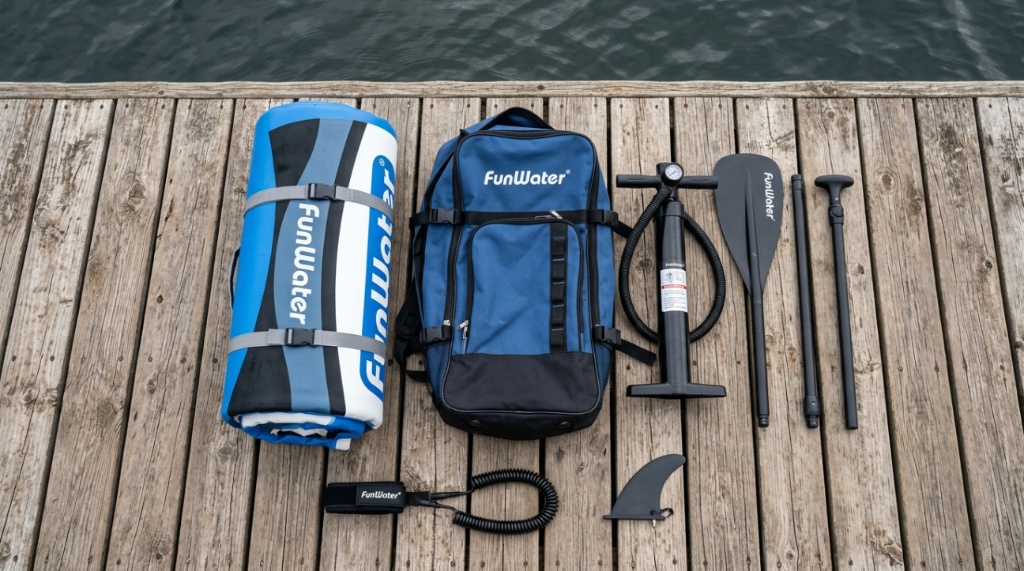
Included in the box, you will generally find the board, a backpack, a coil leash, a repair kit, a safety whistle, and a manual pump, along with a 3-piece aluminum paddle. This is a “complete” kit, meaning you don’t need to buy anything else immediately aside from a personal flotation device (PFD) if required by law.
The Aluminum Paddle
This is the weakest link for many users. The paddle is heavy and lacks the stiffness of fiberglass or carbon shafts. While it works for a casual paddle, the weight becomes fatiguing on longer excursions. Additionally, the plastic blade often slips on the shaft during hard strokes if not locked down tightly, which can be frustrating.
The Manual Pump
Inflating to the necessary 12-15 PSI with the included manual pump is a workout in itself. It has a dual-action mode (pushing and pulling), which speeds things up, but the small barrel size means you’ll be pumping for a solid 10-15 minutes. This initial effort is a common reason why many iSUP owners end up purchasing an electric pump later, adding to the total cost of ownership.
Portability and Storage: The Inflatable Advantage
The main advantage of the FunWater, like all iSUPs, is portability. The included backpack (which is often a bit bulky but functional) allows you to pack the board into the trunk of a car or carry it on public transit. This is vital for people without dedicated rooftop racks. The board rolls down smaller than a sleeping bag, making storage in an apartment closet or under a bed easy. The trade-off is that packing the board up after a session takes about 10-15 minutes, which can be a deterrent for a quick after-work paddle, whereas a hardboard is ready to launch immediately.
Maintenance and Longevity: Making It Last
With proper care, a FunWater board can last multiple seasons. The most critical rule is to avoid leaving it in direct sunlight for extended periods when inflated. UV rays degrade the PVC, and the expanding air can over-pressurize the seams, causing delamination. After use, rinse it with fresh water, especially if you’ve been in salt or brackish water, and dry it thoroughly before rolling it up to prevent mildew. A common mistake is over-tightening the roll, which can crease and weaken the material at the same spot every time. Loosely roll it and fold it into the bag as instructed. is critical to preserving its structural integrity to ensure you get several years of use out of this budget-friendly investment.
Who Should Buy It? (And Who Shouldn’t)
To determine if the FunWater is worth it, you need to be honest about your paddling style.
Consider the FunWater if you are:
- A Complete Beginner: Buying an expensive high-end board while you are unsure if you’ll enjoy the sport is risky. The FunWater offers a low-cost entry point. If you use it five times and let it collect dust, you haven’t lost a massive amount of money.
- A Casual Paddler: If your goal is to leisurely float on calm lakes or gentle rivers once or twice a week while chatting with friends, this board is sufficient.
- On a Tight Budget: If the cost of a Red Paddle or an iRocker is prohibitive, the FunWater provides a way to get onto the water this season without needing to save for another year.
Avoid the FunWater if you are:
- An Advanced Paddler: If you are upgrading from a rental or a cheap board and looking for better glide and rigidity, you will be disappointed. This board won’t offer the performance improvement you’re after.
- Interested in Fitness/Touring: The heavy paddle and slow hull make this a poor choice for cardio-focused workouts or long-distance expeditions.
- Engaged in Yoga: The soft deck pad and flex underfoot make balance poses more difficult than on a dedicated, thicker yoga board.
Price vs. Value: The Real Verdict
So, is it worth it? Yes, but only within the context of its price point. If you pay $200-$300 dollars for a FunWater board, you are getting a piece of equipment that is worth roughly that price. It performs adequately for its cost. The “value” isn’t that it’s a great SUP; the value is that it’s a *good enough* SUP for a fraction of the cost of premium models. It allows access to the sport. The problem arises when buyers expect this board to perform like a $1,500 board simply because they are happy with the design. If you go in with realistic expectations—that you are buying a basic, heavy, but stable watercraft for casual use—you will likely be satisfied with your purchase. If you expect high-end performance, you will be let down. The board will be the limiting factor in your progression, not the other way around.
Frequently Asked Questions
Is the FunWater SUP good for beginners?
Yes. Its wide base and stable platform make it very forgiving for first-time riders who are still learning their balance. However, beginners should be aware that the weight and flexibility of the board mean they will need to build up their paddling strength to maintain speed.
Can you use the FunWater SUP for surfing?
It is not recommended. The board is too heavy and lacks the rocker (curvature) and stiffness needed to catch and maneuver waves effectively. It is best suited for flat water conditions like lakes and calm bays.
How long does a FunWater board last?
With proper care, storage, and maintenance, you can expect 2-4 seasons of regular casual use. The lifespan significantly extends to 5+ years if you use it infrequently and treat it gently. Inflating to the correct PSI and avoiding UV exposure are critical to longevity.
Do I need an electric pump for this SUP?
No, the manual pump works, but it is physically demanding to reach the recommended PSI. An electric pump is a highly convenient upgrade that saves time and effort, but it is an additional expense. It is recommended if you have a physical condition that makes pumping difficult or if you plan to paddle multiple times per week.
Conclusion
Ultimately, the FunWater inflatable SUP is a board of compromises. It compromises on rigidity, performance, and accessory quality, but it compromises in favor of affordability and accessibility. It is not a “cheap” board in the sense that it will break immediately—it is a “budget” board that requires you to lower your performance expectations. For the right buyer—specifically, a new paddler on a tight budget who plans to stick to calm water—this board is absolutely worth the investment. It offers a safe, stable, and fun way to enjoy the water without the hefty price tag of premium brands. But for anyone who has outgrown beginner gear or who prioritizes speed and fitness, you are better off saving your money and investing in a higher-tier board that will keep up with your ambitions.