How Seattle, WA Bakers Stop Soft Loaves From Dropping in the Oven
Seattle’s notoriously damp, cool climate creates a unique challenge for home bakers and professionals alike. Studies show that humidity levels above 70% can increase dough fermentation speed by as much as 30%, making loaf collapse far more common in the Pacific Northwest than in drier regions. Many bakers in Seattle have also noticed that a bread loaf collapsed in bread machine shares the same root causes as oven-baked sinkage, pointing to a consistent pattern of over-proofing and humidity stress. Understanding the science behind that frustrating drop is the first step toward baking loaves that rise tall and stay that way.
Why Soft Loaves Drop in Seattle’s Climate
Seattle’s weather sits at the intersection of marine air and mountainous terrain, which keeps moisture levels elevated year-round. Flour absorbs ambient humidity before it even reaches your mixing bowl, changing its hydration balance without you adding a single extra drop of water. This hidden moisture absorption weakens gluten structure before the dough even begins to ferment. Many bakers don’t realize the problem starts at the pantry, not the oven.
When gluten strands become overly hydrated, they lose the elasticity needed to trap carbon dioxide during baking. The dough rises quickly in Seattle’s warm kitchens during summer or heated homes in winter, but the gas cells expand faster than the gluten network can support. At the moment oven heat sets the crust, the structure underneath is already collapsing. Understanding this sequence helps bakers intervene at exactly the right point.
Temperature swings between Seattle’s neighborhoods also play a role. A kitchen in Capitol Hill may run 5 to 7 degrees warmer than one in Ballard just a few miles away due to urban heat differences. Even a small temperature increase dramatically speeds up yeast activity and shortens the safe proofing window. Knowing your kitchen’s baseline temperature is, therefore, a non-negotiable first step in Seattle baking.
One helpful way bakers test their oven’s dry heat performance before committing to a full loaf is by using a quick surface heat check. Learning from techniques like the quiet sizzle test for heat can help bakers verify that their oven is genuinely at the set temperature before loading their dough. Many ovens in older Seattle homes run significantly cooler than the dial suggests. Correcting for this discrepancy prevents underbaked centers that collapse under their own weight.
The Role of Flour Selection and Protein Content
Not all flours perform equally in a high-humidity environment, and Seattle bakers learn this lesson quickly. Bread flour with a protein content of 12 to 14 percent builds stronger gluten networks that resist collapse far better than all-purpose alternatives. Higher protein content means more gluten-forming glutenin and gliadin molecules, which create a sturdier internal scaffold. That scaffold must be strong enough to hold the loaf’s rise even as ambient moisture tries to weaken it.
Some experienced Seattle bakers go a step further by blending high-gluten flour with a small percentage of vital wheat gluten powder. Adding just one to two teaspoons of vital wheat gluten per cup of flour noticeably increases the dough’s ability to hold its shape under humid conditions. This technique is especially popular in local artisan bakeries that deal with large batch production. The adjustment is subtle but makes a measurable difference in final loaf height.
Stone-milling enthusiasts in Seattle’s thriving local grain movement sometimes favor heritage wheat varieties like Red Fife or Sonora. These grains offer unique flavor profiles, but their lower gluten content requires careful hydration management. Bakers using heritage flours often reduce their water by 5 to 8 percent to compensate for the weaker structure. They also tend to shorten their proofing time to prevent over-fermentation before the loaf enters the oven.
Mastering Proofing Time in Pacific Northwest Kitchens
Over-proofing is the single most common reason soft loaves drop, and Seattle’s unpredictable kitchen temperatures make it especially tricky to manage. Yeast thrives between 75 and 95 degrees Fahrenheit, and even a slightly warm kitchen can push dough past its peak rise without any visible warning. By the time the dough looks perfectly domed in the pan, it may already be 20 to 30 minutes past its structural limit. Learning to identify peak proofing by touch and texture rather than by appearance is a skill that separates seasoned Seattle bakers from beginners.
The classic poke test remains one of the most reliable proofing checks a baker can use. Press a lightly floured finger about half an inch into the dough and observe how it responds. If the indent springs back quickly and completely, the dough needs more time. If it springs back slowly and only partially fills in, the dough is at its ideal proof. If the indent stays sunken and doesn’t spring back at all, the dough is already over-proofed and likely to drop in the oven.
Seattle bakers dealing with inconsistent kitchen temperatures often use cold retarding as a proofing control method. After shaping, they place the loaf in the refrigerator overnight and bake it directly from cold the next morning. Cold fermentation slows yeast activity, builds more complex flavor, and dramatically reduces the risk of over-proofing. This approach has become standard practice in many Seattle home kitchens precisely because it removes the climate variable from the equation entirely.
Choosing accurate tools is equally important when managing proofing temperatures. Knowing how to choose between instant-read vs probe thermometers matters for bread baking too, since both can monitor dough temperature and final internal doneness with precision. A well-baked loaf should reach an internal temperature of 190 to 210 degrees Fahrenheit at the center. Bakers who pull the loaf out too early often mistake a pale crust for doneness, only to watch the center sink as it cools.
Shaping Techniques That Prevent Interior Collapse
Proper shaping creates surface tension in the dough that acts as a natural support structure during oven spring. Many bakers focus entirely on proofing and ingredient ratios while overlooking the physical technique that gives the loaf its internal scaffolding. A tightly shaped loaf with good surface tension will resist collapse far more effectively than a loosely formed one, regardless of hydration level. This is especially true in Seattle’s climate, where the dough is already fighting against ambient moisture.
The pre-shape and bench rest sequence is a method that many professional bakers in Seattle use religiously. After the first rise, the dough is lightly shaped into a round, covered, and allowed to rest for 20 to 30 minutes before the final shaping. This rest relaxes the gluten so the baker can achieve a tighter final shape without tearing the surface. Tearing destroys the tension that keeps the loaf standing tall through the bake.
For sandwich loaves baked in a pan, rolling and tucking the dough firmly before placing it seam-side down creates a smooth, taut outer skin. That skin tightens further as oven heat hits it, creating a shell that supports the crumb structure as it bakes. Bakers who skip this step often end up with loaves that dome briefly in the oven and then sink back as the internal structure fails to keep pace. A firm, deliberate shaping motion is one of the most underappreciated defenses against loaf drop.
The Unusual Seattle Trick: Barometric Pressure Awareness
Here is a detail almost no baking blog discusses, yet experienced Seattle bakers quietly account for it every time a storm rolls in off Puget Sound. Barometric pressure affects how quickly gas expands inside dough, and Seattle experiences significant pressure drops before and during its frequent rain systems. Lower atmospheric pressure means gas bubbles in dough expand more aggressively, pushing the loaf to rise faster and taller than the gluten structure can safely support. This is not folklore; it is basic physics that applies directly to fermentation.
During a low-pressure weather system, Seattle bakers report needing to reduce their yeast quantity by 10 to 15 percent compared to a high-pressure clear day. Some veteran bakers check their phone’s weather app for barometric pressure before measuring their yeast, treating it as a routine part of recipe preparation. This habit is especially common among bakers who sell at farmers markets like the University District Farmers Market or Pike Place. Adjusting yeast quantity proactively prevents the rapid over-rise that leads directly to collapse.
Bakers can also use a slightly higher baking temperature on low-pressure days to set the crust faster before the loaf over-expands. Adding 10 to 15 degrees Fahrenheit to the initial bake temperature for the first 10 minutes helps build a firm outer structure quickly. This technique is sometimes called a heat burst, and it is surprisingly effective at locking in loaf height before the internal gases have a chance to over-expand. No other baking resource tied to Seattle’s specific atmospheric pattern covers this adjustment in practical terms.
Steam, Crust Formation, and Oven Setup
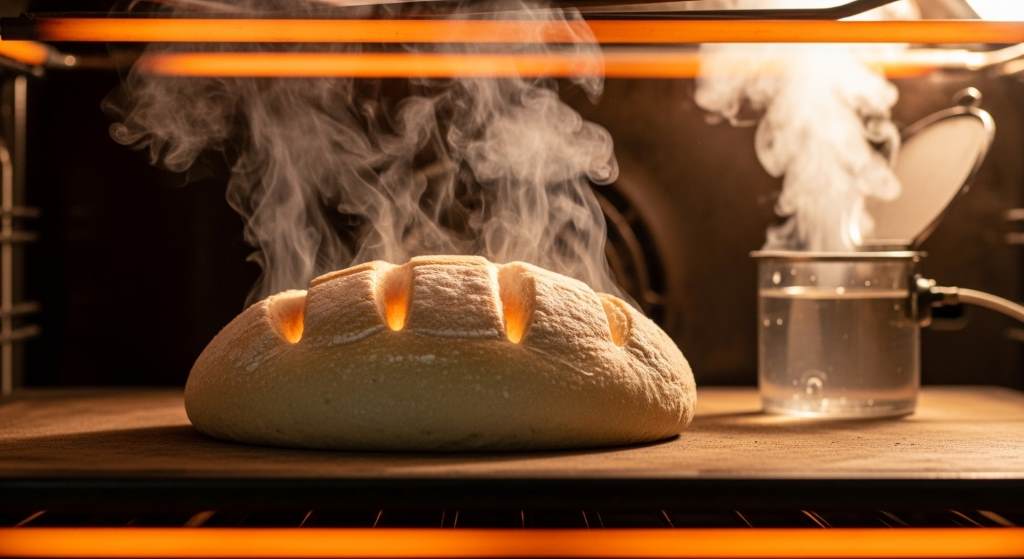
Steam during the first stage of baking keeps the crust soft and flexible so the loaf can expand upward without cracking prematurely. Without enough steam, the crust sets too quickly and restricts oven spring, causing internal pressure to build unevenly and often triggering a sidewall collapse. Many Seattle bakers use a cast iron skillet on the oven’s lower rack, pouring boiling water into it just before closing the door. This creates a burst of steam that mimics the professional deck ovens used in commercial bakeries.
After the initial steam phase, the oven door should stay closed and the steam should be vented to allow the crust to crisp and set firmly. Some bakers crack the oven door for the last 10 minutes of baking to encourage moisture escape and crust hardening. A properly set crust acts as a structural shell that prevents the soft interior from sinking as the loaf cools. Neglecting this final drying phase is a common mistake that leads to loaves that look perfect in the oven but drop on the cooling rack.
Preheating a Dutch oven or covered baking vessel is another technique that produces exceptional results for free-form loaves. The enclosed space traps natural steam from the dough itself during the first 20 minutes of baking. After removing the lid, the crust quickly crisps and hardens, locking in the rise. Seattle bakers who switched to Dutch oven baking often describe it as the single change that finally eliminated their loaf-drop problem.
Cooling Correctly After the Bake
Many collapsed loaves are not actually a baking failure but a cooling failure. Cutting into a hot loaf or placing it on a solid surface immediately after baking traps steam inside, which weakens the crumb structure and causes it to sink under its own weight. Always transfer a freshly baked loaf to a wire cooling rack so that air circulates freely around the entire surface. This allows internal steam to escape evenly rather than condensing back into the crumb.
A standard sandwich loaf needs at least 45 minutes to one hour of cooling before slicing. Artisan rounds and sourdough loaves benefit from two full hours or more, as their denser crumb requires more time to set completely. Rushing this step is one of the most common mistakes bakers make after investing significant effort into the bake itself. Patience during cooling is just as important as precision during mixing and proofing.
Seattle’s cool ambient temperatures actually work in a baker’s favor during cooling. The marine air helps loaves cool evenly and quickly compared to hot, dry climates where the cooling surface temperature can cause uneven setting. Placing the cooling rack near an open window on a typical Seattle overcast day provides an ideal slow-cool environment. Bakers who take advantage of this natural cooling condition report consistently firmer crumb structure in their finished loaves.
Equipment Choices That Make a Consistent Difference
Reliable equipment removes the guesswork that leads to inconsistent results and collapsed loaves. Heavy-gauge loaf pans, preferably made from aluminized steel or carbon steel, distribute heat more evenly than thin or lightweight alternatives. Even heat distribution ensures the loaf sets uniformly from the edges to the center, reducing the risk of a raw core that collapses after slicing. Seattle bakers who invest in quality pans consistently report better structural results over time.
Oven thermometers are an inexpensive tool that every Seattle baker should keep inside their oven at all times. Many ovens, especially in older Seattle homes built in the mid-twentieth century, can run 25 to 50 degrees cooler than their dials indicate. Baking at an unintentionally low temperature leaves the loaf’s internal structure underdeveloped, which guarantees sinkage. A five-dollar oven thermometer eliminates this variable completely.
Bakers who enjoy exploring kitchen tools and automated options sometimes wonder about different appliance-based approaches. Reading up on resources like best pasta maker machines illustrates how the right appliance can transform a time-consuming manual process into a consistent, repeatable one. The same principle applies to bread baking, where consistent tools produce consistent outcomes. Investing in a kitchen scale, a reliable thermometer, and quality pans pays dividends in every single bake.
Conclusion
Stopping soft loaves from dropping in the oven comes down to understanding and controlling the variables that Seattle’s climate introduces at every stage of the baking process. From flour selection and barometric pressure awareness to proper shaping, steam management, and patient cooling, each step builds on the last to create a loaf that rises tall and stays there. Seattle’s damp, pressure-variable weather is not the enemy; it is simply a condition that rewards informed bakers who adapt their technique with intention and consistency. Apply these strategies on your next bake and experience the difference that climate-aware baking truly makes.
Start with one change at a time, whether that is switching to high-protein flour, trying a cold overnight proof, or investing in an oven thermometer. Track your results, adjust where needed, and share what works with your fellow Seattle bakers. A community of well-informed bakers raises everyone’s loaf. Take these strategies into your kitchen today and bake with the confidence that comes from understanding exactly why your bread behaves the way it does.
Frequently Asked Questions
Why does my bread always sink in the middle after baking?
Your bread sinks in the middle primarily because it was over-proofed before entering the oven, causing the gluten structure to collapse under the weight of its own gas bubbles.
Does Seattle’s humidity actually affect my bread dough?
Yes, Seattle’s high ambient humidity adds hidden moisture to your flour and dough, which accelerates fermentation and weakens gluten structure if you don’t compensate by reducing water or shortening proof time.
How do I know when my bread dough is perfectly proofed?
Use the poke test: press a floured finger half an inch into the dough, and if the indent springs back slowly and only halfway, the dough is at its ideal proof stage.
Can barometric pressure really affect my bread loaf at home?
Yes, low barometric pressure before Seattle rain systems causes gas in dough to expand more aggressively, so reducing yeast by 10 to 15 percent on stormy days helps prevent over-rise and collapse.
What is the best internal temperature for a fully baked bread loaf?
A fully baked bread loaf should reach an internal temperature between 190 and 210 degrees Fahrenheit, confirming the crumb is fully set and will not sink during cooling.