
7 Mistakes People Make When Buying a Hobo Shoulder Bag
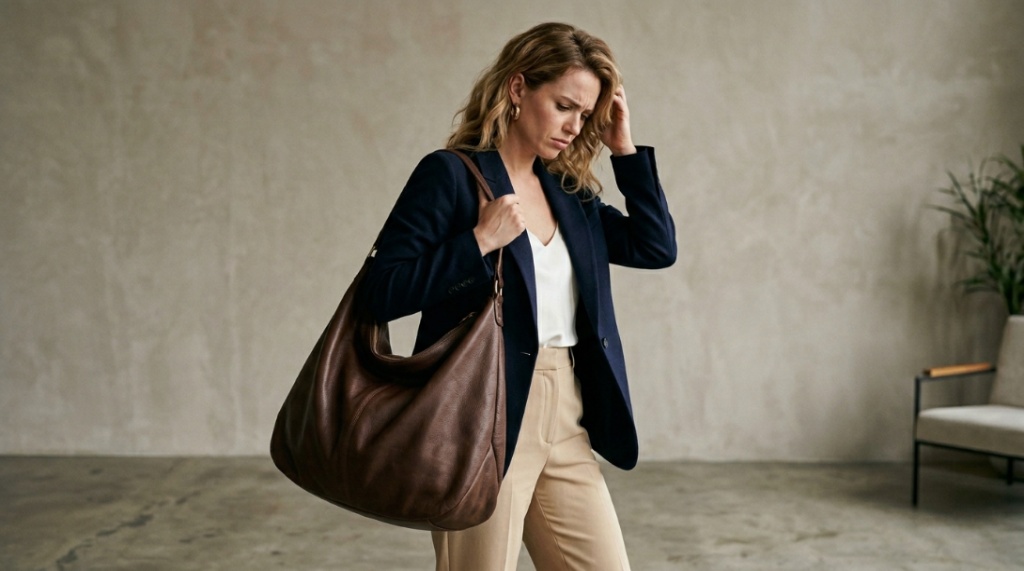
Nearly 60% of handbag returns happen within the first two weeks — and hobo bags have one of the highest return rates among bag silhouettes because their unique construction punishes uninformed buying decisions harder than any other style. Avoiding mistakes when purchasing a hobo shoulder bag saves you the frustration of cycling through bags that looked perfect online but failed in real life. A hobo shoulder bag is a crescent-shaped, soft-bodied bag with a single shoulder strap that relies on material quality and construction precision for both aesthetics and function — because without internal structure, the bag is only as good as its leather, stitching, and design choices. The problem with hobo bags specifically? Their unstructured nature amplifies every quality shortcut and design flaw. A poorly chosen hobo doesn’t just disappoint — it becomes a shapeless, uncomfortable, disorganized mess within weeks. This handbag buying guide details the seven most damaging mistakes buyers make with hobo bags, why each mistake matters, and exactly how to avoid them — turning your next purchase into your last return.
Mistake #1: Choosing Based on Photos Instead of Testing With Real Weight
The most damaging mistake is buying a hobo bag based solely on how it looks in product photos — without testing how it performs when loaded with your actual daily contents at realistic weight.
Why this destroys hobo bag satisfaction:
Hobo bags are photographed empty or stuffed with tissue paper — displaying their ideal silhouette under zero-weight conditions. The moment you add a phone, wallet, keys, water bottle, and cosmetics (2–4 lbs), the bag transforms. The strap digs differently. The silhouette stretches. The bottom sags. Closures strain. What looked elegant online becomes uncomfortable and unflattering under real conditions.
How to avoid it:
- Always bring your actual daily carry items to test in-store. Place them inside and wear the bag for 3–5 minutes minimum.
- For online purchases: order with intent to test immediately upon delivery. Load the bag, wear it around your home for 30 minutes, then decide. Return within the policy window if performance disappoints.
- Check the bag’s weight empty — anything over 2 lbs empty will feel noticeably heavy once loaded. Light empty weight (under 1.5 lbs) indicates better daily comfort potential.
- Pay attention to strap behavior under load. Does it stay on your shoulder? Does it dig? Does the bag swing forward when you walk? These problems only appear under real weight.
Mistake #2: Ignoring Strap Width and Attachment Quality
Thin straps and weak attachment points are the #1 failure mode in hobo bags — yet buyers consistently evaluate leather, color, and brand while ignoring the component that determines whether the bag remains usable past six months.
Why this matters specifically for hobo bags:
Unlike tote bags with two handles sharing weight, or crossbody bags distributing load across the torso, hobo bags concentrate all weight through one strap at two attachment points. This single-strap dependency means:
- Every ounce of weight channels through these two connection points
- Daily wear creates repetitive stress on strap material and stitching
- The strap width directly determines whether weight spreads across your shoulder (comfortable) or digs into a narrow line (painful within 30 minutes)
What to check:
| Component | Acceptable (Minimum) | Ideal (Premium) | Red Flag (Avoid) |
|---|---|---|---|
| Strap width | 1 inch | 1.5–2 inches | Under 0.75 inch |
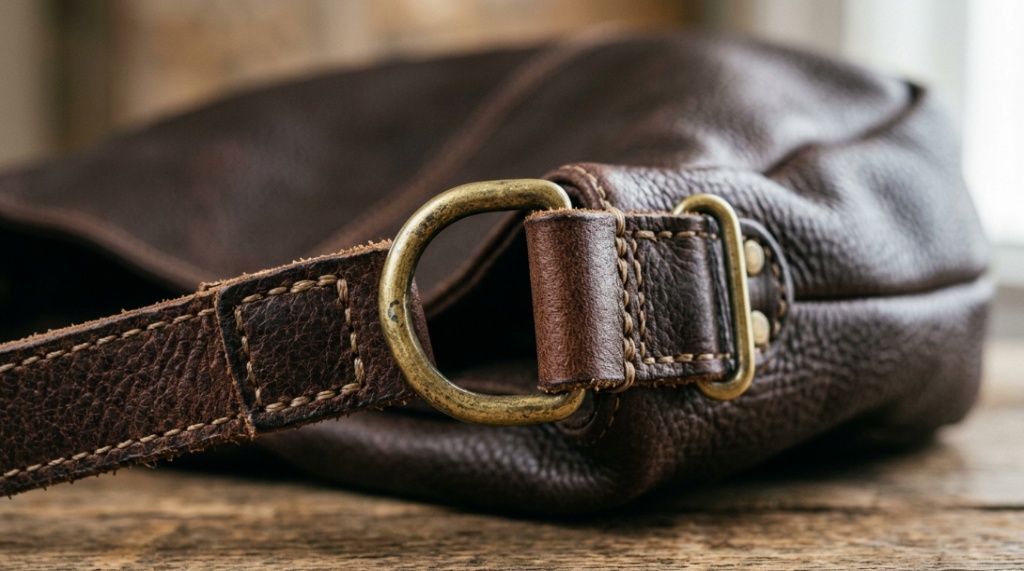
| Attachment method | Stitched with reinforcement | Rivets + stitching + leather backing | Stitching only, no reinforcement |
| Strap material | Same leather as body | Thicker leather or padded construction | Thinner leather than body |
| Strap flexibility | Moderate flex, holds shoulder curve | Soft yet supportive, conforms naturally | Rigid (slips off) or too limp (folds) |
| Attachment point flex | Zero visible flex under pull | Reinforced plate behind leather | Any wobble or give when pulled |
Test method: grip the strap firmly and pull straight down with moderate force. Watch the attachment point. Any flex, stretch, or movement at the connection indicates future failure under daily weight. Walk away regardless of how beautiful the rest of the bag appears.
Mistake #3: Buying Cheap Leather That Won’t Age Gracefully
Budget leather (bonded, split, or heavily corrected) in hobo bags deteriorates visibly within 3–6 months of daily use — peeling, cracking, and losing shape in ways that structured bags partially hide but unstructured hobos expose completely.
Why hobo bags amplify cheap-leather problems:
Structured bags have internal framing that maintains shape even as leather deteriorates. Hobo bags have no internal support — the leather IS the structure. When cheap leather softens beyond its intended flexibility, the bag collapses entirely. When it dries and cracks, every imperfection shows because the surface is the only visual element without hardware or structure to distract.
Quality leather in a hobo bag improves with age — developing patina, character, and softness that enhance the slouchy silhouette. Cheap leather in a hobo bag degrades with age — showing its cheapness more obviously with every week of use.
Minimum material standards for a hobo bag that lasts:
- Top-grain or full-grain leather (check product description for specific grade)
- Minimum 1mm thickness for bag body (thinner leather loses shape within months)
- Natural smell when sniffed closely (chemical/plastic smell = avoid)
- Visible grain variation under natural light (perfect uniformity = coated/corrected/fake)
- Price minimum of $150 for genuine leather hobo bags — below this threshold, material compromises are nearly guaranteed
The investment difference: a $250 quality leather hobo lasts 5–8 years. Three $80 cheap leather replacements over the same period cost $240 while providing inferior daily experience every single day. Quality is cheaper long-term.
Mistake #4: Selecting the Wrong Size for Your Body and Carry Habits
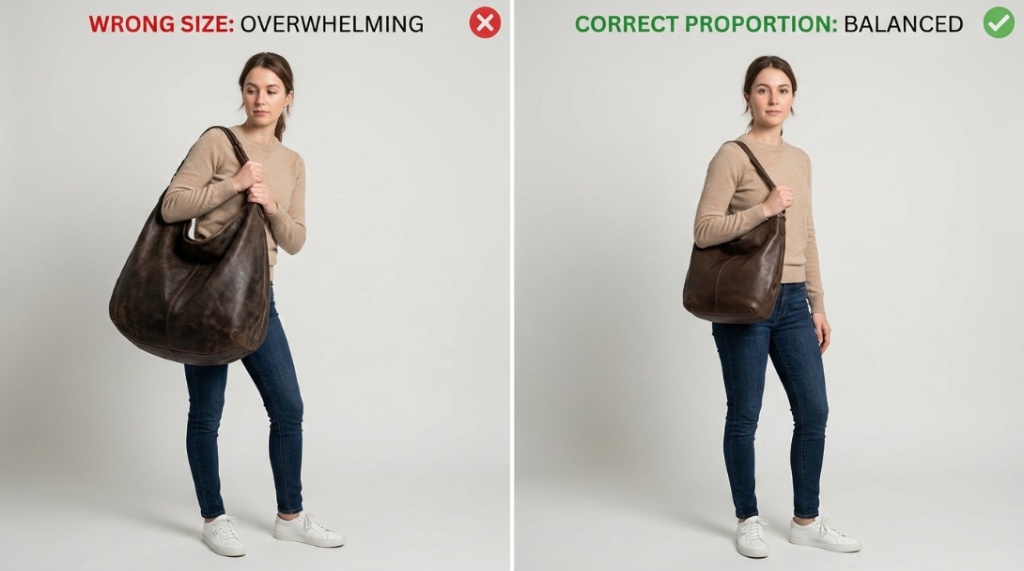
Choosing a hobo bag too large creates physical discomfort and sloppy appearance, while too small forces daily compromises on what you can carry — and the crescent shape makes sizing less intuitive than rectangular bags.
Hobo-specific sizing challenges:
- Width ≠ usable space. A 14-inch hobo doesn’t provide 14 inches of interior width. The crescent curve means usable flat width is typically 65–75% of total measurement. A 14-inch hobo provides roughly 9–10 inches of practical flat space for rectangular items like books or tablets.
- Depth disappears quickly. Hobo bags appear spacious but the crescent bottom narrows capacity dramatically. Large items must orient toward the center — competing for the same space rather than distributing across a flat base.
- Body proportion matters more than with structured bags. An oversized hobo against a petite frame looks like the bag is wearing the person. A too-small hobo against a taller frame looks like an afterthought. The bag should complement your proportions, not fight them.
Size selection guide:
- Petite frames (under 5’3″): 10–12 inch hobos. Maximum visual harmony without overwhelming your silhouette.
- Average frames (5’3″–5’7″): 12–14 inch hobos. The sweet spot for most daily carry needs while maintaining proportional balance.
- Tall/larger frames (5’7″+): 13–16 inch hobos. Larger proportions prevent the bag from looking undersized.
Always test with your body, wearing your typical clothing, viewing in a full-length mirror. The bag should hang between your armpit and hip — not above and not below. This placement zone is where hobo bags look most intentional and carry most comfortably.
Mistake #5: Overlooking Interior Organization Completely
Assuming you’ll “figure out organization later” leads to the universal hobo bag complaint: spending cumulative hours fishing through a shapeless main compartment for keys, phone, or wallet that has migrated to the crescent’s deepest point.
Why this mistake hits hobo bags hardest:
Structured bags hold items in predictable positions. Tote bags let you see contents from above. Hobo bags do neither — the soft body allows items to shift with every movement, the curved interior creates a gravity well where small items disappear, and the single-compartment design provides zero natural separation.
Essential organization features to require (not hope for):
- Interior zip pocket: Non-negotiable. Secures wallet or valuables without fear of falling out when the bag tilts during daily use.
- Phone-accessible slip pocket: Must fit your specific phone model for single-hand retrieval without looking. Test this with your actual phone — even a millimeter too tight ruins usability.
- Key attachment: A clip, leash, or D-ring near the top opening that keeps keys findable without excavation. Some brands include this; others require you to add your own keychain with clip.
- Exterior pocket (bonus): A back or side pocket for transit cards, small items needed without opening the main compartment. Not all hobo designs accommodate this without breaking silhouette — but when present, it’s a major usability upgrade.
If your chosen hobo lacks interior organization: buy a bag organizer insert ($15–$40 on Amazon) specifically designed for hobo shapes. These felt or nylon inserts add pockets and mild structure without altering the exterior’s relaxed appearance. This $25 addition can transform a disorganized hobo into a perfectly functional daily bag.
Mistake #6: Disregarding Closure Type for Your Daily Environment
Choosing an open-top hobo for environments involving crowds, public transit, or frequent bending means your belongings are perpetually at risk of falling out or being accessed by others — a security and practical failure that renders beautiful design irrelevant.
Closure types and their real-world implications:
- Open top (no closure): The most aesthetically relaxed option — and the most functionally risky. Items fall out when you bend over. Pickpocket access is unrestricted. Rain enters freely. Only appropriate for controlled environments (car-to-office, low-crime areas, indoor-only days).
- Magnetic snap: Provides basic closure that prevents accidental item loss during bending and moderate movement. However, magnets separate easily under pull — not secure against intentional access in crowded environments.
- Zip-top closure: Maximum security. Items stay contained regardless of movement, position, or environment. Essential for commuters, travelers, and anyone in crowded public spaces. Slight trade-off: zipping and unzipping adds 2–3 seconds to each access.
- Drawstring/gathered: Moderate security with easy access. The gathered top cinches closed naturally but opens quickly for retrieval. Good balance between security and convenience.
- Flap with clasp: Secure and professional-looking. Takes longest to access but provides excellent protection. Best for settings where you access the bag infrequently.
Match your closure to your life: urban commuters need zip-top or secured magnetic. Suburban drivers with car-to-destination routines can use magnetic or even open-top. Travelers need zip exclusively. Don’t let aesthetic preference override practical security assessment — a stolen wallet or broken phone eliminates any aesthetic benefit permanently.
Mistake #7: Buying for Trend Without Considering Long-Term Style Alignment
Purchasing a hobo bag because the silhouette is trending — without verifying it genuinely fits your established personal style — leads to a bag that feels forced within months as initial trend excitement fades and the novelty-driven purchase sits unused.
How to distinguish trend attraction from genuine style alignment:
- Check your history: Have you owned and loved a slouchy bag before? If your past bag history is entirely structured totes and crossbodies, a hobo may not align with your instinctive preferences regardless of current trends.
- Wardrobe compatibility audit: Try pairing the hobo mentally with your 10 most-worn outfits. Does it enhance 7+ of them naturally? Or does it only work with 2–3 outfits you’d wear specifically to “match” the new bag?
- Comfort with soft silhouettes: Hobo bags look relaxed by nature. If you’re someone who feels most confident with everything precise and structured, the hobo’s intentional slouch may register as “sloppy” to your internal eye — creating discomfort every time you carry it.
- Body language test: Put the bag on in-store and walk naturally for 2 minutes without looking in a mirror. Then stop and assess: does it feel like yours? Does it feel like a costume? Your physical comfort response is more honest than your visual assessment in a mirror.
The safest approach if you’re hobo-curious but unsure: buy your first hobo at mid-range pricing ($150–$300) rather than luxury ($800+). Test the silhouette in real life for a full season. If it becomes your most-reached-for bag organically — then invest in a luxury version knowing the style genuinely serves your life.
When avoiding these buying traps, remember that your bag should match your daily environment. For instance, if you are transitioning from casual weekend wear to a corporate classroom setting, you will want a silhouette with a bit more structure than a standard slouchy slouch bag. Exploring dedicated options like Professional Teacher Handbags for a Polished Look can help you strike that perfect balance between effortless hobo utility and workplace sophistication.
Conclusion
These seven mistakes share one root cause: prioritizing appearance over performance in a bag category where performance depends entirely on quality and design choices invisible in photos. Hobo shoulder bags reward careful buying more than any other bag style because their unstructured nature means every shortcut — thin straps, cheap leather, missing pockets, wrong size — manifests as daily frustration rather than hiding behind rigid construction.
Buy a hobo bag the smart way: test under realistic weight, verify strap quality obsessively, invest in leather that ages beautifully, choose the right size for your body, demand interior organization, select appropriate closures for your environment, and ensure the style genuinely fits your wardrobe rather than just your trend curiosity. Get these seven elements right, and your hobo bag becomes the most loved, most carried, most satisfying accessory in your daily rotation.
Frequently Asked Questions
What’s the most important thing to check when buying a hobo bag?
Strap attachment quality. Because hobo bags concentrate all weight through a single strap at two connection points, attachment failure renders the entire bag unusable. Check for multiple reinforcement methods (rivets plus stitching), adequate strap width (minimum 1.5 inches for daily use), and zero flex when the attachment point is pulled. Everything else can be supplemented, but strap failure cannot be fixed without professional repair.
How do I know if a hobo bag is too big for me?
A hobo bag is too big if it hangs below your hip bone, if the bottom of the bag extends past your waist when worn, or if you feel overwhelmed by the bag’s volume relative to your body in a full-length mirror. The bag should sit between your armpit and hip, and its maximum width should not exceed your torso width. If it overwhelms your silhouette proportionally, size down.
Are hobo bags harder to keep organized than other styles?
Yes — inherently. Their soft, unstructured interior lets items shift freely, and the crescent shape creates a deep center where small items disappear. However, this is solvable with proper pocket selection during purchase and/or a bag organizer insert ($15–$40) that adds compartments without altering exterior aesthetics. Organization is a fixable challenge, not a fundamental flaw.
How much should I spend on my first hobo bag?
$150–$300 for a quality leather hobo that lets you test the silhouette in your real life before making a luxury investment. This range delivers genuine top-grain leather, adequate construction, and comfortable straps from brands like Madewell, Coach, Fossil, and Hobo International. If the style proves itself over 3–6 months of regular use, then consider upgrading to a luxury version with confidence.
Can a hobo bag work for commuting on public transit?
Yes, with the right specifications: zip-top closure (security in crowds), wide strap (comfort during standing), medium size (not oversized for crowded spaces), and lightweight construction (under 1.5 lbs empty to minimize total carry weight). Avoid open-top hobos and oversized versions for daily transit commuting — security and space considerations override aesthetic preferences in this context.
What’s the difference between a cheap hobo bag and an expensive one?
The primary differences are leather grade (full-grain ages beautifully, bonded leather peels), strap durability (reinforced vs. basic stitching), hardware quality (solid metal vs. plated plastic), interior finishing (lined vs. raw), and longevity (5–15 years vs. 6–18 months). The external appearance may look similar initially, but within 3 months of daily use, cheap bags visibly deteriorate while quality bags improve with character development.
Should I buy a hobo bag online or in-store?
In-store for your first hobo bag purchase — always. The silhouette’s unique properties (strap comfort under load, proportional fit against your body, closure functionality, interior access) require physical testing that photos cannot replicate. Once you know your preferred brand, size, and specifications from in-store testing, subsequent purchases of similar styles can safely happen online with confidence in your requirements.